
Study Notes · Market Maker Primer
Study Notes: Market Maker Primer – The ICT Smart Money Technique or SMT
 by Anthony TranUpdated on Aug 3, 2025
- Min read
- 5
- Sections
- 11
Disclaimer: Educational content based on personal experience, not financial advice. Futures trading involves substantial risk. Read full disclaimer
In this article
These are my study notes from ICT Market Maker Primer – The ICT Smart Money Technique or SMT. I’m documenting them for personal review and to share my trading journey.
Original ICT video: https://www.youtube.com/watch?v=isXicdayBwA
What is SMT?
The Smart Money Technique (SMT) is like having X-ray vision for the forex market. It helps you see what the big money players are really doing behind the scenes.
Think of it this way: when you see a magic trick, you only see what the magician wants you to see. But if you knew the secret, you could predict what happens next. SMT is that secret for trading.
The Simple Idea Behind SMT
Here’s the basic concept that even a 7th grader can understand:
The U.S. Dollar and other currencies are like a seesaw.
- When the dollar goes up, other currencies usually go down
- When the dollar goes down, other currencies usually go up
- But sometimes this doesn’t happen – and that’s when SMT becomes powerful
How SMT Works (The Seesaw Example)
Imagine you and your friend are on a seesaw:
Normal Situation:
- You go down → Your friend goes up
- You go up → Your friend goes down
SMT Situation (This is the magic!):
- You try to go down, but your friend doesn’t go up much
- This means something is wrong with the seesaw
- Maybe your friend is getting heavier (stronger)
In trading terms:
- Dollar tries to go up, but other currency doesn’t go down much
- This means that currency is getting stronger (smart money is buying it)
Two Types of SMT Signals
1. Bullish SMT (Currency Will Go Up)
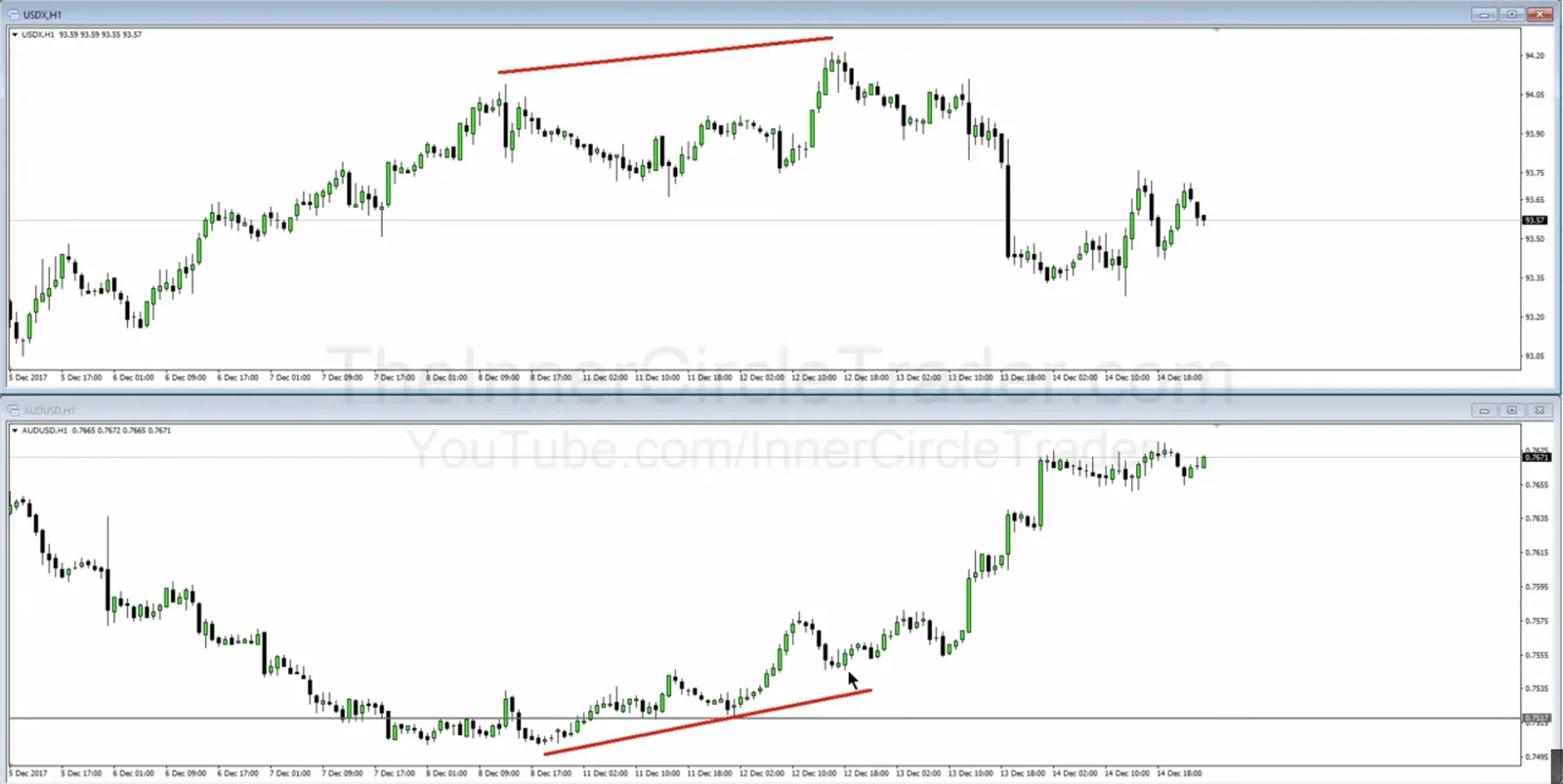
What to look for:
- Dollar Index makes a higher high
- BUT the currency pair fails to make a lower low
- This means: Smart money is buying that currency
Example:
- Dollar Index goes from 95 to 96 (higher high)
- EUR/USD stays around 1.1000 instead of dropping to 1.0950
- Signal: Euro is getting stronger – time to buy EUR/USD
2. Bearish SMT (Currency Will Go Down)
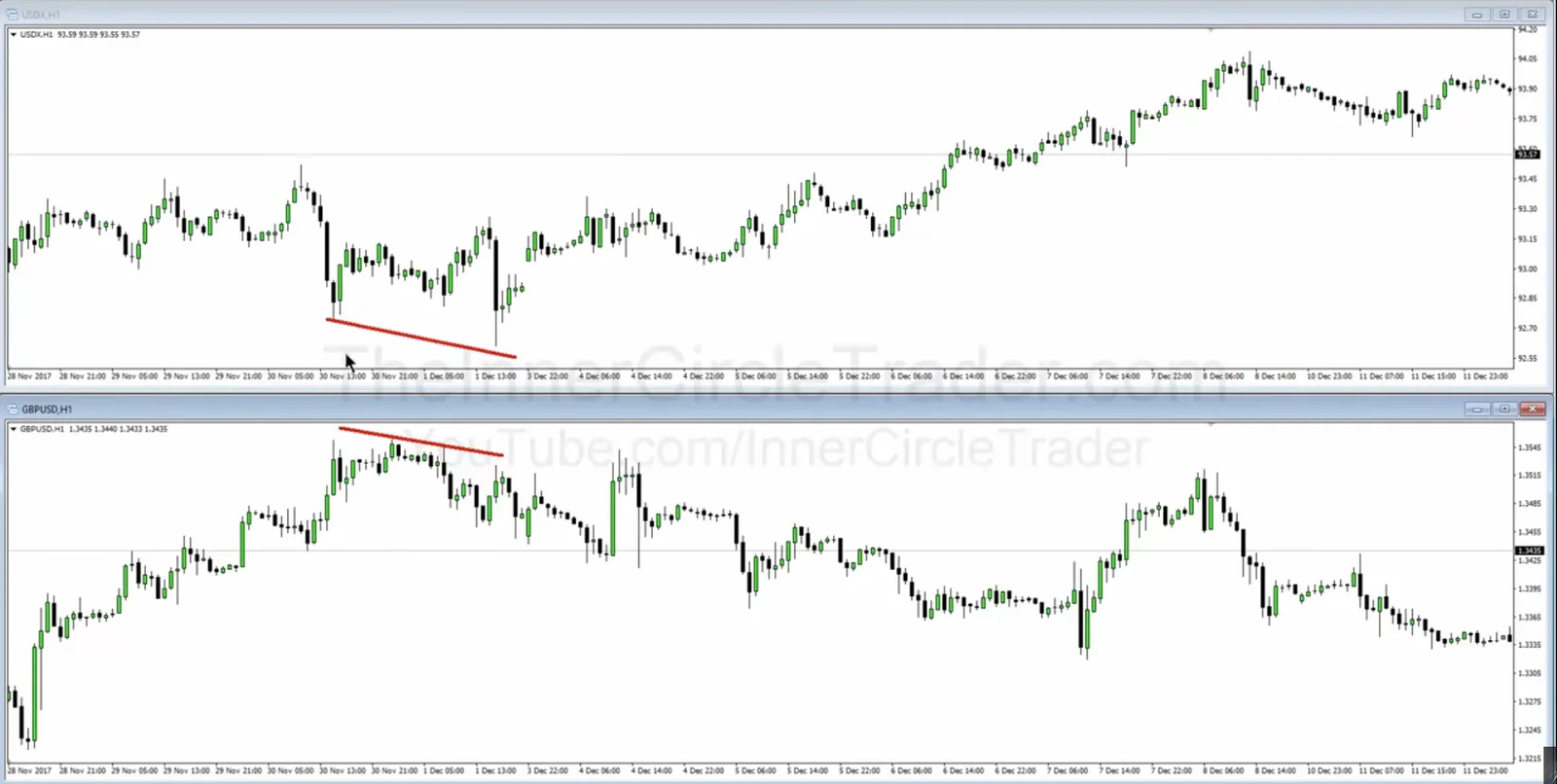
What to look for:
- Dollar Index makes a lower low
- BUT the currency pair fails to make a higher high
- This means: That currency is weak – smart money is selling it
Example:
- Dollar Index drops from 96 to 95 (lower low)
- GBP/USD stays around 1.2500 instead of rising to 1.2600
- Signal: British Pound is weak – time to sell GBP/USD
Real Trading Example (Made Simple)
Let’s say you’re watching the Australian Dollar (AUD/USD):
Step 1: Look at both charts side by side
- AUD/USD on one screen
- Dollar Index on another screen
Step 2: Wait for the magic moment
- Dollar Index makes a new high at 97.50
- AUD/USD should drop to a new low, but it doesn’t
- Instead, AUD/USD only drops a little bit
Step 3: This is your signal!
- Smart money is secretly buying Australian Dollars
- The seesaw is broken – this means AUD will go up soon
- Time to buy AUD/USD
Why This Works
Smart money (big banks and institutions) can’t hide their moves completely. When they start buying or selling large amounts, it shows up as these “broken seesaw” moments.
It’s like trying to hide an elephant in your backyard. No matter how hard you try, the neighbors will notice something’s different.
How to Use SMT in Your Trading
Step 1: Set Up Your Charts
- Open two charts: one currency pair and the Dollar Index
- Use the same time frame for both (like 1-hour charts)
- Line them up so you can see the same time periods
Step 2: Look for the Pattern
- Watch for moments when the seesaw breaks
- Mark these spots on your charts
- This is where smart money is making moves
Step 3: Plan Your Trade
- Bullish SMT: Look to buy the currency pair
- Bearish SMT: Look to sell the currency pair
- Wait for a good entry point (don’t rush in immediately)
Step 4: Manage Your Risk
- Always use stop losses
- Start with small position sizes while learning
- Keep a trading journal to track your SMT trades
Common Mistakes to Avoid
- Don’t trade every SMT signal – Wait for clear, obvious ones
- Don’t ignore the bigger picture – Make sure the overall trend supports your trade
- Don’t risk too much – SMT is powerful but not 100% accurate
- Don’t rush – Take time to confirm the signal before trading
Practice Makes Perfect
Before risking real money:
- Paper trade – Practice with fake money first
- Study past examples – Look at old charts and find SMT patterns
- Start small – When you do trade real money, use tiny amounts
- Be patient – It takes time to master this technique
The Bottom Line
SMT is like being a detective in the forex market. You’re looking for clues that show what the smart money is really doing. When you find these clues, you can follow the smart money and potentially profit from their moves.
Remember: The goal isn’t to be right 100% of the time. The goal is to find high-probability setups where you can make more money when you’re right than you lose when you’re wrong.
Key Takeaways
- SMT shows when the normal relationship between currencies breaks down
- This breakdown reveals where smart money is positioning
- Look for currencies that don’t move as expected when the dollar moves
- Always use proper risk management
- Practice extensively before trading with real money
The Smart Money Technique is a powerful tool, but like any tool, it takes practice to use effectively. Start slow, be patient, and focus on learning rather than making money quickly. With time and practice, SMT can become a valuable part of your trading toolkit.
Disclaimer: Trading involves substantial risk and is not suitable for all investors. Past performance does not guarantee future results. This content is for educational purposes only and should not be considered financial advice. Always consult with a qualified financial advisor before making trading decisions.
Keep reading