Prop Firm Reviews
The 7 Best Prop Trading Firms for Beginners in 2026: A Trader’s Guide
 by Anthony TranUpdated on Mar 9, 2026
- Min read
- 20
- Sections
- 09
Disclaimer: Educational content based on personal experience, not financial advice. Futures trading involves substantial risk. Read full disclaimer
In this article
Choosing your first proprietary trading firm can feel like a high-stakes decision. With dozens of options, each boasting different rules, evaluation challenges, and payout structures, it’s easy for a new trader to get lost or make a costly mistake. This guide is built to cut through that complexity and provide a clear path forward. We are focused on identifying the best prop trading firms for beginners by analyzing what truly matters: understandable rules, fair evaluations, and a straightforward process to get your profits.
This article provides a detailed breakdown of the top 7 beginner-friendly prop firms. For each firm, we will examine critical details often buried in the fine print.
You’ll get actionable insights on:
- Evaluation Rules: Specific profit targets, maximum drawdown types (trailing vs. end-of-day), and daily loss limits.
- Account Fees: The initial cost of challenges, reset fees, and any recurring data or platform charges.
- Payout Policies: How profit splits work, minimum withdrawal amounts, and the frequency of payouts.
- Common “Gotchas”: Hidden rules or platform limitations that can trip up new traders.
We will review Topstep, Earn2Trade, Apex Trader Funding, and others, complete with screenshots and direct links to get you started. The goal isn’t just to help you pass a trading challenge; it’s to equip you to select a firm that supports a sustainable trading career. Let’s find the right partner to fund your trading journey.
1. Topstep
Topstep stands out as one of the longest-running and most reputable names in the futures prop trading space. It has built a strong reputation around education, transparency, and a structured path to funding, making it a reliable choice for newcomers. The firm’s core product is the “Trading Combine,” an evaluation process designed to test a trader’s discipline and risk management skills in a real-time simulated environment.

Unlike firms with convoluted rules, Topstep provides extensive documentation and clear guidelines, which is a major advantage for beginners trying to understand the prop firm model. If you’re new to the world of funded futures accounts, their resources can help you better understand how futures prop firms work. This focus on clear communication helps traders avoid accidental rule violations.
The Topstep Evaluation Model
The Trading Combine is available in three account sizes: $50K, $100K, and $150K. The evaluation is a single-step process where you must meet a profit target without breaking specific risk rules.
- Profit Target: The goal you must reach to pass the evaluation.
- Maximum Loss Limit: A hard stop based on your unrealized P&L. If your account balance hits this level at any point, the account is closed.
- Daily Loss Limit: A cap on how much you can lose in a single trading day.
Once you pass the Trading Combine, you transition to a funded account. Topstep offers a unique 100% payout on your first $5,000 to $10,000 in profits (depending on the account size), which is a great incentive. After that, the profit split is a generous 90/10, where you keep 90% of the profits.
Beginner’s Tip: Topstep’s rule structure is consistent and well-documented. Before you start, spend time in their help center reading the exact definitions for the Daily Loss Limit and Maximum Loss Limit. Understanding these rules is more important than hitting the profit target quickly.
Key Considerations for Novices
While Topstep is one of the best prop trading firms for beginners, there are two important points to consider. First, on the standard pricing plan, there is a one-time “activation fee” when you first get funded. This fee can be avoided by choosing the slightly more expensive monthly subscription upfront. Second, payouts are not available from day one. You must record five “Winning Days” of over $200 each to request your first payout, a system designed to encourage consistent profitability rather than a single lucky trade.
- Pros:
- Veteran company with a proven track record and reliable support.
- Clear, well-documented rules and payout policies.
- Excellent educational resources and community for new traders.
- Keep 100% of your first $5K-$10K in profits.
- Cons:
- Activation fee for funded accounts on the standard pricing plan.
- Payouts require meeting a “Winning Day” benchmark, which can slow access to profits.
Website: https://www.topstep.com
2. Earn2Trade (Gauntlet Mini)
Earn2Trade takes an education-first approach, positioning itself as a firm dedicated to developing traders through structured assessments. Its flagship product for beginners is the Gauntlet Mini, an evaluation program that not only tests profitability but also enforces discipline through specific rules like minimum trading days and consistency requirements. This makes it an excellent choice for new futures traders who want a guided path to funding.

The firm’s focus on structured learning is apparent in its detailed documentation and support materials. The rules are clearly explained, helping beginners avoid common pitfalls. For those completely new to the asset class, their resources offer a solid foundation for understanding the core concepts of futures trading for beginners. This emphasis on education helps build a trader’s confidence alongside their account balance.
The Earn2Trade Evaluation Model
The Gauntlet Mini is a one-step evaluation that requires traders to meet a profit target while adhering to several key rules designed to promote consistent, disciplined trading.
- Profit Target: A fixed goal you must reach to pass the challenge.
- End-of-Day Drawdown: Your account balance cannot dip below a specific threshold calculated at the end of each trading day. This is often more forgiving for beginners than a trailing drawdown.
- Minimum Trading Days: You must place a trade on at least 10 different days to qualify.
- Consistency Rule: No single trading day can account for more than 30% of your total profit.
After passing, traders can choose to enter a LiveSim account, a simulated environment with real money at stake, before moving to a live brokerage account. This acts as a helpful bridge for novices. The profit split is 80/20, meaning you keep 80% of your profits.
Beginner’s Tip: Pay close attention to the Consistency Rule. It’s designed to stop you from passing with one lucky trade. Focus on making small, consistent gains across multiple days rather than aiming for one huge winning day.
Key Considerations for Novices
While Earn2Trade is one of the best prop trading firms for beginners due to its educational focus, there are costs to consider. Once you are funded, you are responsible for professional market data fees, which are a monthly expense. Additionally, the rules, while helpful for building discipline, can feel restrictive. The minimum trading days and consistency requirements may not suit traders who prefer a very fast, aggressive scalping style.
- Pros:
- Strong emphasis on education with clear, well-documented rules.
- The LiveSim phase helps beginners transition from evaluation to a live funded account.
- End-of-Day drawdown is easier to manage than a trailing drawdown.
- Generous 80/20 profit split from the start.
- Cons:
- Market data fees are an ongoing cost for funded traders.
- Consistency and minimum day rules can be restrictive for certain trading styles.
Website: https://www.earn2trade.com
3. Apex Trader Funding
Apex Trader Funding has quickly become a dominant force in the futures prop firm industry, largely due to its frequent, aggressive promotions and straightforward one-step evaluation process. It’s known for offering a wide array of account sizes and maintaining a highly active community, making it an appealing option for traders who want flexibility and a lower cost of entry. The firm also builds trust by publicly posting its payout logs and program updates, offering a degree of transparency that many beginners appreciate.
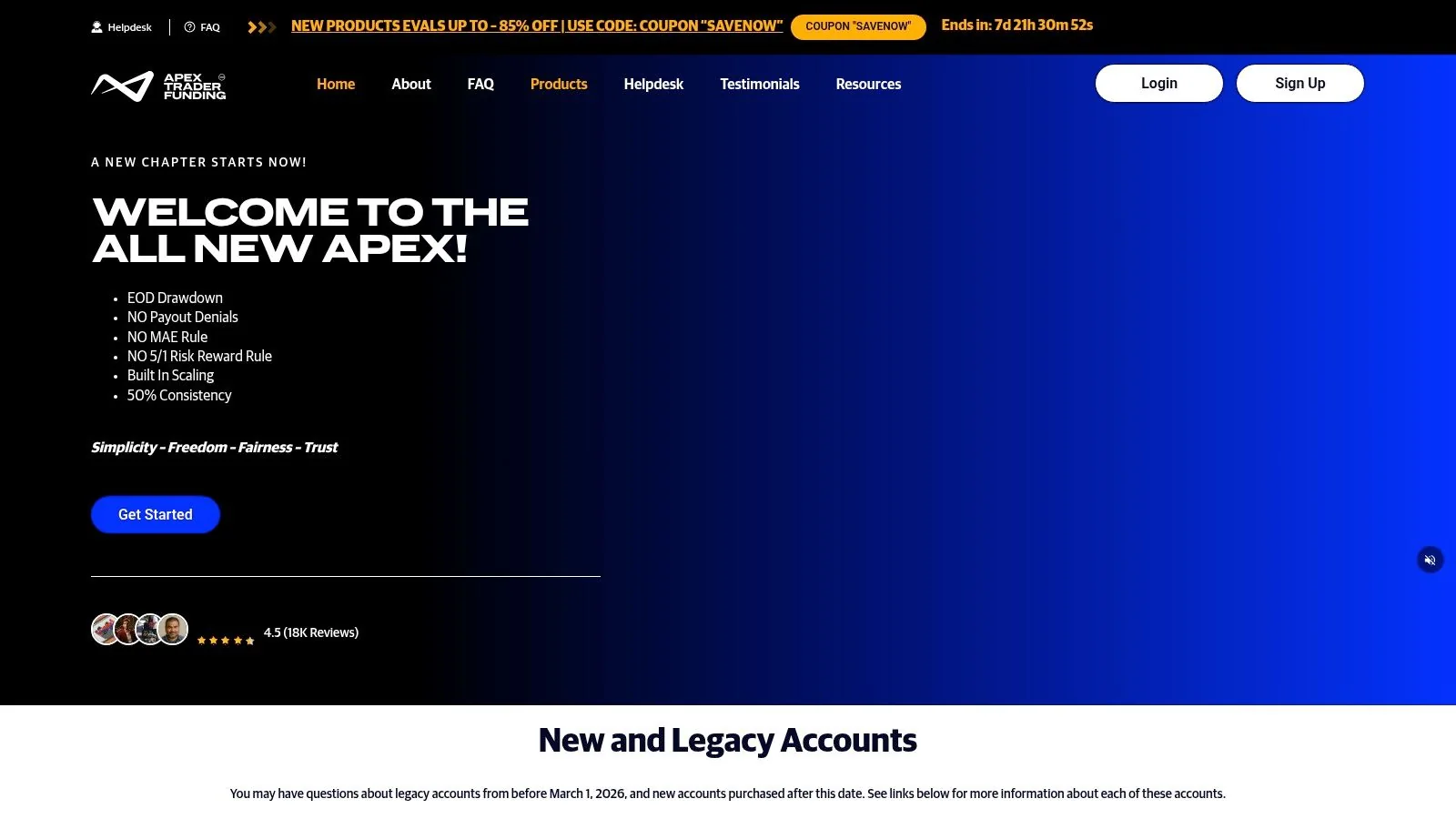
Unlike firms with rigid pricing, Apex almost always has a significant discount running, often providing 80% or even 90% off the evaluation fee. This makes it one of the most accessible firms for those on a tight budget. Their rules are relatively simple, but it is critical to understand their trailing drawdown model. The trailing drawdown updates at the end of the day, which can be less punishing than real-time drawdowns. To fully grasp this, it’s wise to use a prop firm end-of-day trailing drawdown calculator to model different scenarios.
The Apex Trader Funding Evaluation Model
Apex offers a single-step evaluation across numerous account sizes, from $25K up to $300K. To pass, a trader must trade for a minimum of seven days and reach a profit target without hitting the trailing drawdown limit.
- Profit Target: A fixed goal that must be met to qualify for a funded “PA” (Performance Account).
- Trailing Drawdown: The maximum allowable drawdown, which trails your highest account balance on an end-of-day basis.
- Minimum Trading Days: You must place a trade on at least seven separate days to be eligible for funding.
Once you pass the evaluation, you are moved to a Performance Account. Apex follows a 90/10 profit split, where the trader keeps 90% of their earnings. The first $25,000 in profits is 100% yours, after which the 90% split applies. Payouts are processed on a weekly basis, which is faster than many competitors.
Beginner’s Tip: Always wait for a major promotion before signing up for an Apex evaluation. These discounts are frequent and dramatically reduce your initial risk. Also, keep a close eye on their official announcements, as rules and promotional details can change.
Key Considerations for Novices
While Apex is a strong contender for the best prop trading firm for beginners due to its low entry cost, there are a couple of points to be aware of. First, there is a one-time activation fee for each Performance Account you qualify for. Second, while payouts are fast, they come with processing fees. The first few withdrawals have a higher fee, which then drops for subsequent requests. This is a documented cost that should be factored into your profit planning.
- Pros:
- Extremely low entry cost during their frequent, deep discount promotions.
- Simple, one-step evaluation process with clear rules.
- Wide range of account sizes provides flexibility for all trading styles.
- Keep 100% of your first $25,000 in profits and receive payouts weekly.
- Cons:
- Rules and promotions change often, requiring you to stay updated.
- Payouts come with documented processing fees.
Website: https://apextraderfunding.com
4. OneUp Trader
OneUp Trader appeals to beginners with its straightforward, single-step evaluation and transparent rules. The firm focuses on simplicity, removing common hurdles like daily loss limits during the evaluation, which can give new traders more breathing room. Its primary offering is a one-step challenge where the main objective is to hit a profit target without violating the trailing drawdown rule, making it a solid choice for those who prefer a clear and concise path to a funded account.
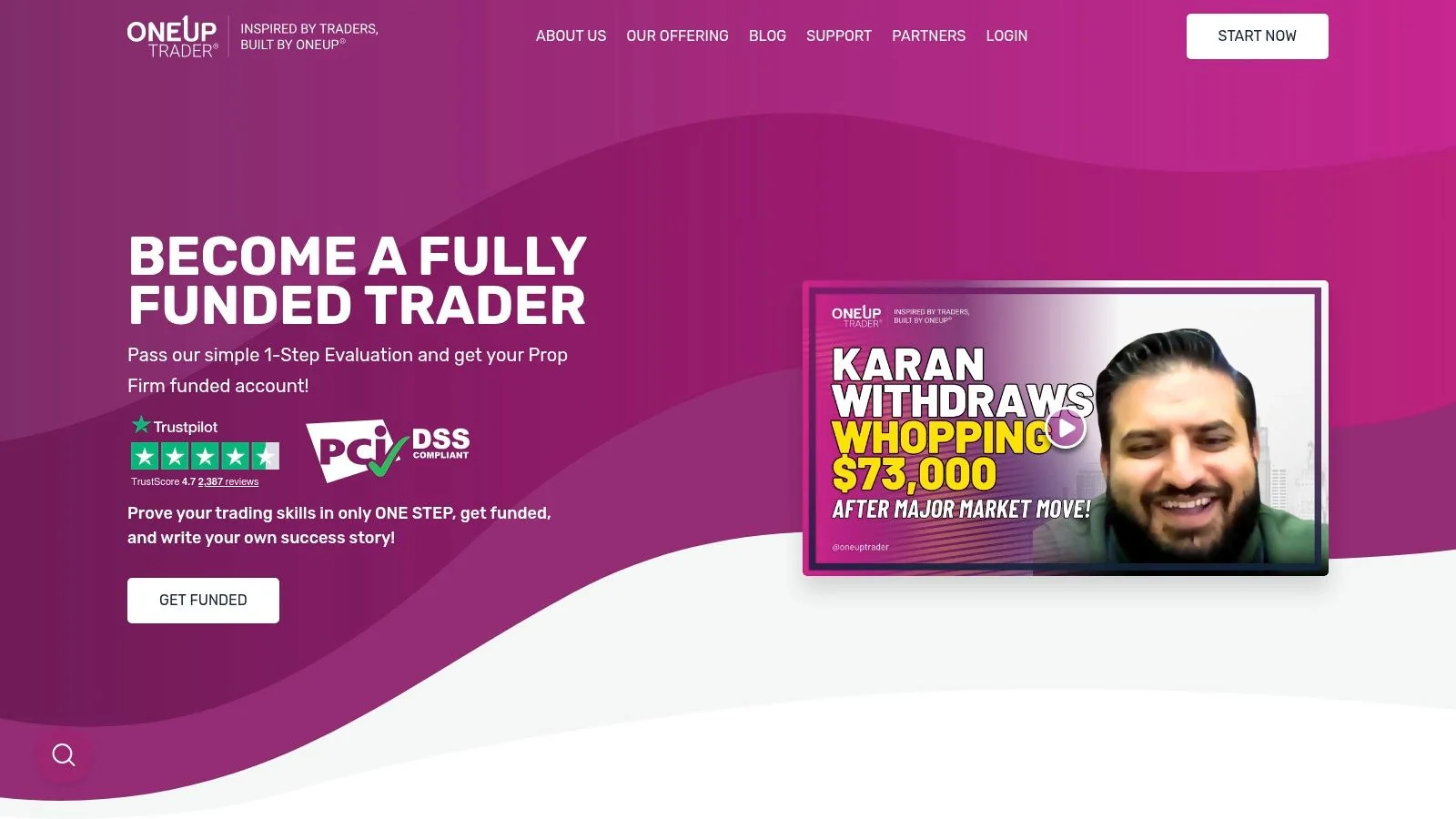
A significant advantage for cost-conscious traders is that OneUp provides a free NinjaTrader license and covers market data fees for funded accounts. These ongoing costs can add up, so having the firm cover them removes a financial burden once you pass the evaluation. This commitment to supporting funded traders makes OneUp Trader one of the best prop trading firms for beginners looking to minimize expenses.
The OneUp Trader Evaluation Model
OneUp offers a single-phase evaluation across several account sizes, from $25K up to $250K. Traders must trade for a minimum of 10 trading days (not necessarily consecutive) and meet their profit target to qualify.
- Profit Target: A fixed goal you must reach to pass.
- Trailing Drawdown: This is the key risk parameter. It trails your account’s peak balance and acts as a maximum loss level. Unlike a daily loss limit, it is calculated based on your highest unrealized profit during a trade.
- No Daily Loss Limit: During the evaluation, there is no cap on how much you can lose in a single day, as long as you stay above the trailing drawdown threshold.
Once you pass, you move to a funded account with a generous profit split. You keep 100% of your first $10,000 in profits, and then the split moves to a 90/10 arrangement, which is very competitive.
Beginner’s Tip: The trailing drawdown is calculated intraday, meaning it includes your unrealized profits. Be extremely careful not to let a winning trade turn into a big loser, as this can quickly move your drawdown threshold up and put your account at risk. Always use a stop-loss.
Key Considerations for Novices
The main challenge with OneUp Trader is its trailing drawdown model. While the absence of a daily loss limit is appealing, the intraday trailing drawdown requires strict discipline. If you are not accustomed to managing your positions tightly, it can be easy to violate this rule. Also, while the evaluation is a one-time fee, if you fail and need to reset, the costs can accumulate, so it’s important to be well-prepared before starting.
- Pros:
- Simple, one-step evaluation with no daily loss limit.
- Free NinjaTrader license and CME data for funded traders, reducing ongoing costs.
- Keep 100% of your first $10,000 in profits, followed by a 90/10 split.
- Reputable firm with strong community support.
- Cons:
- The intraday trailing drawdown can be difficult for beginners to manage.
- Monthly evaluation fees can become expensive if you require multiple attempts.
Website: https://www.oneuptrader.com
5. TradeDay
TradeDay has carved out a niche by focusing on trader flexibility and support, offering a blend of evaluation models and robust educational resources. It appeals to beginners who want more control over their risk parameters and appreciate an active community. The firm provides a clear pathway to funding with a strong emphasis on mentoring, daily webinars, and direct support, which can be invaluable for traders building their confidence and strategy.

Unlike firms with a rigid, one-size-fits-all approach, TradeDay allows traders to choose from different drawdown models during the evaluation. This customization is a significant advantage, as it lets you align the account rules with your specific trading style. Whether you prefer an End-of-Day (EOD), intraday, or static drawdown, TradeDay has an option that can accommodate your risk management approach.
The TradeDay Evaluation Model
TradeDay offers a single-step evaluation with various account sizes. A key feature is the choice of drawdown type, which directly impacts how risk is managed.
- Profit Target: The minimum profit required to pass the evaluation.
- Drawdown Models: Choose between Intraday Trailing, End-of-Day Trailing, or Static Drawdown.
- Consistency Rules: The firm has rules to ensure profitability isn’t the result of a single lucky trade.
Once you pass, you move to a funded account where you can request payouts from day one, provided your account balance is above the initial starting balance plus a safety buffer. This buffer is equal to the maximum drawdown of the account. Payout requests are processed quickly, often within 24 hours on business days. The profit split starts at 80% and increases to 90% and then 95% as you reach lifetime withdrawal milestones.
Beginner’s Tip: The choice of drawdown is critical. An EOD drawdown is often more forgiving for intraday traders than a trailing drawdown that updates in real-time. Before starting, carefully analyze your strategy to determine which model gives you the best chance of success.
Key Considerations for Novices
TradeDay’s immediate payout access is a major draw, but it’s important to understand the buffer system. You can only withdraw profits that are above the initial balance plus the drawdown amount. This means you must build a cushion before you can access your first payout. Additionally, the evaluation includes rules around news trading and consistency, which may not suit every trading strategy, particularly scalpers or news-focused traders.
- Pros:
- Fast payouts (often within 24 hours) with day-one access after clearing the buffer.
- Multiple drawdown models (Intraday, EOD, Static) to fit different trading styles.
- Strong educational layer with daily webinars, mentoring, and an active community.
- Profit split improves from 80% up to 95% with continued success.
- Cons:
- The payout buffer system requires you to build significant profit before your first withdrawal.
- Evaluation rules, such as news restrictions and consistency requirements, can be restrictive for some strategies.
Website: https://www.tradeday.com
6. Leeloo Trading
Leeloo Trading earns its spot by offering a notable degree of flexibility, which can be a significant advantage for beginners trying to find their footing. The firm provides a wide array of evaluation account types, each with different rules, pricing, and objectives. This variety allows new traders to choose a path that aligns with their specific trading style, risk tolerance, and budget, rather than forcing them into a one-size-fits-all model.
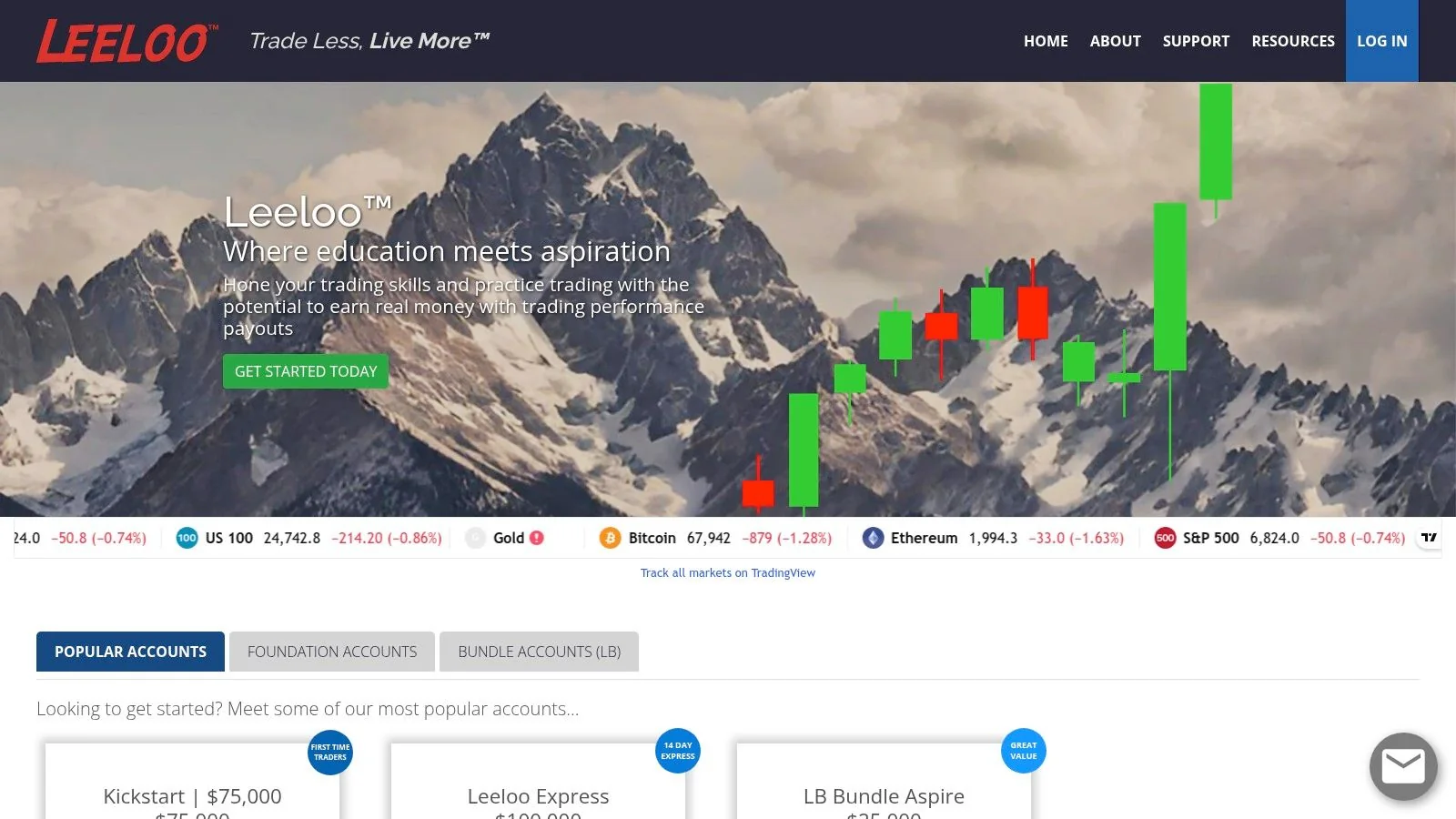
Frequent promotions and discounts make Leeloo one of the more accessible options for traders on a tight budget. Their core strength lies in plan customization, from low-cost entry points to unique drawdown rules that can reduce the psychological pressure on a developing trader. This makes it one of the best prop trading firms for beginners who want to test the waters without a major financial commitment.
The Leeloo Evaluation Model
Leeloo’s evaluation landscape is diverse, featuring account types like the Entry (LE), Foundation, and various specialty accounts. While the specifics differ, the core components remain consistent with the industry standard.
- Profit Target: A set profit goal you must reach to pass the evaluation.
- Trailing Drawdown: A maximum loss that follows your account’s peak balance. This is the most critical rule to understand.
- Minimum Trading Days: You must trade for a certain number of days to qualify.
A standout feature on some of Leeloo’s accounts is the “Threshold” or “Safety Net.” Once your account balance reaches a specific high-water mark, the trailing drawdown can “lock” in place, effectively turning it into a static drawdown. This is a huge benefit, as it allows you to build a profit buffer without the fear of the drawdown creeping up behind you with every winning trade.
Beginner’s Tip: Pay close attention to the account type you choose. An “LE” or “Entry” account might have a very low monthly fee during a sale, but the rules could be stricter. A “Foundation” account might cost more but offer features like the drawdown lock. Always read the fine print for the specific evaluation you purchase.
Key Considerations for Novices
The sheer number of choices at Leeloo can be overwhelming for a newcomer. It’s crucial to spend time on their website and help center to understand the differences between each plan. Some accounts have low upfront costs but require ongoing monthly data fees in the Performance Account (funded stage), while others have a higher one-time fee to cover those costs for life. Understanding this trade-off is key to managing your expenses as a funded trader. The flexibility is a major plus, but it puts the responsibility on you to pick the right path.
- Pros:
- Highly flexible evaluation options to suit different trading styles and budgets.
- Frequent and deep discounts make it one of the most affordable entry points.
- Drawdown “lock” feature on certain accounts reduces long-term risk pressure.
- Cons:
- The wide variety of plans and rules can be confusing for new traders.
- Ongoing data fees apply to some funded accounts unless a lifetime option is purchased.
- Payout policies and fees can vary significantly between account types.
Website: https://leelootrading.com
7. Take Profit Trader (TPT)
Take Profit Trader (TPT) has carved out a niche in the prop firm industry with a singular focus on payout flexibility. Built around a “get paid any day” model, the firm appeals to traders who prioritize quick access to their profits without the traditional hurdles like minimum trading day counts or fixed payout schedules once they are funded. This approach simplifies the withdrawal process, making it a compelling option for beginners who want to see the results of their successful trading quickly.

The firm’s philosophy is straightforward: if you earn it, you should be able to withdraw it. This is managed through a buffer-zone system where any profit generated above the account’s maximum drawdown level becomes withdrawable. This unique mechanism is central to the TPT experience and sets it apart from many competitors that have more rigid payout rules.
The Take Profit Trader Evaluation Model
TPT uses a single-step evaluation process to qualify traders for funding. The rules are clear and focus on proving profitability and risk management without overly complex requirements. Evaluations are available for account sizes ranging from $25K up to $150K.
- Profit Target: A specific profit amount you must reach to pass.
- Do Not Hit Your Max Drawdown: A trailing drawdown that follows your account’s peak balance.
- Trade a Minimum of 5 Days: You must place a trade on at least five separate days.
After passing, you select a funded account tier: PRO or PRO+. The PRO account offers an 80/20 profit split. The PRO+ account costs a bit more upfront but provides a 90/10 split and prevents your maximum drawdown from trailing once it reaches the initial account balance. Payouts for US traders are offered through multiple convenient methods, including Plaid/ACH, PayPal, and Wise.
Beginner’s Tip: The withdrawable profit buffer is the key concept to master. Your max drawdown trails your highest profit point. Any money you make above this trailing drawdown level is your withdrawable cash. Understand this mechanic completely before trading, as it governs both your risk and your payout potential.
Key Considerations for Novices
While TPT’s payout model is one of the most flexible available, it operates on a very strict rule set regarding position management. You must close all positions before the market close each day; failing to do so, even by a few seconds, can result in your account being disabled. This requires discipline. Additionally, while payouts are designed to be fast, some user reports mention delays during initial W-9 tax form processing or other administrative onboarding steps.
- Pros:
- Extremely fast and flexible payouts with no minimum profitable days needed once funded.
- Simple, one-step evaluation with clear rules.
- No daily loss limit in the funded stage, offering more intraday flexibility.
- Cons:
- Very strict cut-off time rules can lead to account violations if not managed carefully.
- Some users report initial payout delays related to tax form processing.
Website: https://www.takeprofittrader.com
Top 7 Prop Trading Firms for Beginners — Comparison
| Firm | Evaluation complexity | Resource requirements & fees | Expected outcomes & payout cadence | Ideal use cases | Key advantages |
|---|---|---|---|---|---|
| Topstep | Multi‑stage Trading Combine (several progression tiers) | Moderate (activation fee on standard path; strong educational resources) | Clear, well‑documented payout path; slower payout timing tied to benchmark days | Beginners seeking structured education and clear rules | Veteran brand, transparent rules, extensive education |
| Earn2Trade (Gauntlet Mini) | Single‑stage Gauntlet Mini with min 10 trading days + LiveSim phase | Moderate; market‑data fees can add up; detailed docs | Teaches transition to funded/live via LiveSim; payouts after live stage | First‑time futures traders wanting hands‑on coaching | Education‑forward program and LiveSim bridge |
| Apex Trader Funding | Flexible, promotion‑driven options with many account sizes | Often low effective entry during promos; payout processing fees apply | Weekly payout cycle; visible payout logs but variable fees | Cost‑sensitive traders who follow promotions and community tips | Frequent discounts, wide account selection, active community |
| OneUp Trader | Simple one‑step evaluation (≈10‑day min), straightforward rules | Subscription costs for evaluation; funded stage includes free market data and NinjaTrader | Transparent profit split and contract limits; funded data/license reduces ongoing cost | Beginners wanting low ongoing platform/data costs | Free funded‑stage data/platform and clear rules |
| TradeDay | Single‑step with buffer model; multiple drawdown styles to choose | Understand buffer math; evaluation fees typical; active coaching resources | Fast withdrawals (~24 business hours); tiered profit split improving over time | Traders needing fast payouts and coaching/community support | Fast, flexible payouts and multiple drawdown options |
| Leeloo Trading | Many plan types (Entry/LE, Foundation, Weekly, Turbo) with plan‑specific rules | Variable: frequent promotions; some plans have ongoing fees unless paid upfront | Plan‑dependent payout mechanics; “lock” options can protect gains | Traders tailoring cost vs speed or who want drawdown locks | Flexible plans, lock features, frequent promotions |
| Take Profit Trader (TPT) | Single‑step, short minimum (≈5 days) with buffer‑zone withdrawable profits | PRO/PRO+ tiers affect splits; multiple payout methods; must learn buffer rules | Day‑one withdrawal capability using buffer; fast, flexible payouts when compliant | Traders who want immediate, frequent withdrawals and simple rules | Very fast, flexible payouts and straightforward rule set |
Making Your Choice and Taking the Next Step
We’ve explored some of the best prop trading firms for beginners, from Topstep’s structured educational path to Apex Trader Funding’s flexible evaluation rules. You’ve seen how firms like Earn2Trade, OneUp Trader, and TradeDay each present unique pathways to a funded account, while others like Leeloo Trading and Take Profit Trader offer distinct advantages in evaluation parameters and payout policies. The journey from aspiring trader to funded professional is not about finding a single “perfect” firm; it’s about finding the one that aligns with your specific circumstances.
Your trading style, risk tolerance, and starting capital are the three pillars that should support your decision. A scalper who trades frequently might find a firm with a very tight trailing drawdown, like an end-of-day (EOD) calculation, nearly impossible to pass. Conversely, a swing trader might be less concerned with intraday drawdown and more focused on the maximum position size allowed.
Key Takeaway: The “best” firm is a myth. The “right” firm is the one whose rules you can follow consistently without fundamentally changing a profitable trading strategy. If you have to bend your strategy into a pretzel to fit the rules, it’s the wrong firm for you.
From Analysis to Action: Your Next Steps
Information overload can lead to analysis paralysis. To move forward effectively, focus on a structured, methodical approach. Don’t just pick the firm with the biggest sale or the largest account size. Instead, treat this decision with the same seriousness you would a critical trade setup.
Here is a practical checklist to guide your final decision:
- Shortlist Your Top 2-3 Firms: Based on our reviews, narrow down the options that resonate most with your trading style and budget. Don’t consider more than three, as it complicates the final choice.
- Model the Drawdown: This is the most critical step. Use a tool like the FinSeeds Drawdown Calculator to simulate your typical trading days. Input your average winning day, average losing day, and worst-case scenario. See how a live trailing drawdown versus an end-of-day drawdown impacts your available buffer. This simple exercise can reveal that a seemingly generous account is actually much riskier for your strategy.
- Compare Costs vs. Payouts: Use the FinSeeds Prop Firm Comparison Tool to place your shortlisted firms side-by-side. Look beyond the monthly fee. Factor in reset fees, data fees, and the payout schedule. A firm with a 90% payout sounds great, but if it has a high minimum withdrawal and a once-per-month payout date, it may be less practical than an 80% split with more flexible access to your earnings.
- Read the Fine Print (Again): Before you enter your credit card information, go directly to the firm’s website and read their FAQ and terms of service. Pay special attention to rules on holding positions over weekends, news trading restrictions, and what happens after you pass the evaluation. The details we’ve covered are your starting point; final verification is your responsibility.
- Commit and Focus: Once you make a choice, commit to it. Hopping between firms and constantly chasing discounts is a recipe for failure. Purchase your evaluation, study the rules one last time, and then focus entirely on executing your trading plan with discipline.
The path to becoming a funded trader is a marathon, not a sprint. The evaluation is your first major milestone. It’s designed to test your consistency, discipline, and risk management-the very skills you need to succeed long-term. By carefully selecting one of the best prop trading firms for beginners and truly understanding its rules, you set the stage for a sustainable trading career. Your next step isn’t just about passing a test; it’s about proving to yourself that you have what it takes.
Keep reading