
Prop Firm Reviews
Top 6 Apex Trader Funding Alternatives for Futures Traders in 2026
 by Anthony TranUpdated on Mar 9, 2026
- Min read
- 20
- Sections
- 08
Disclaimer: Educational content based on personal experience, not financial advice. Futures trading involves substantial risk. Read full disclaimer
In this article
- 011. Topstep: The Veteran with Transparent Rules and Structured Growth
- 022. Earn2Trade (Trader Career Path and Gauntlet Mini)
- 033. Leeloo Trading: Flexible Evaluations and Frequent Payouts
- 044. OneUp Trader: Flexible Entry Costs and a Focus on Consistency
- 055. Elite Trader Funding (ETF): Maximum Flexibility with Multiple Evaluation Paths
- 066. UProfit Trader: The Home for Disciplined Intraday Traders
- 07Apex Trader Funding Alternatives: 6-Platform Comparison
- 08Your Action Plan: Choosing the Right Alternative for Your Trading Career
Apex Trader Funding has certainly made a name for itself in the futures prop firm space, attracting traders with frequent discounts and relaxed rules. However, assuming it's the default best choice can be a costly mistake. The right funding partner depends entirely on your personal trading style, risk management approach, and long-term goals. A firm's structure, particularly its drawdown rules (trailing vs. end-of-day), consistency requirements, and payout policies, can either support your strategy or set you up for failure.
This guide is designed to provide a clear, direct comparison of the top apex trader funding alternatives available today. We’ll cut through the marketing hype and focus on the details that matter. You will find an in-depth analysis of seven leading firms: Topstep, Earn2Trade, Leeloo Trading, OneUp Trader, Elite Trader Funding, and UProfit. For each alternative, we provide a structured breakdown covering:
- Evaluation Rules & Structure: What you need to do to pass.
- Key Pros & Cons: The real-world advantages and disadvantages.
- "Best For" Profile: Pinpointing which type of trader thrives with each firm.
- Fees & Payouts: A clear look at the costs and profit potential.
We’ve included direct links and screenshots for each platform to simplify your research process. This article serves as your central resource for comparing these programs side-by-side, helping you select a funding path that truly aligns with your trading methodology. We will also explore how to use specialized tools, such as the calculators on FinSeeds, to model your risk and understand account parameters before you commit your capital. The goal is to equip you with the knowledge to make a strategic choice, not just follow the crowd.
1. Topstep: The Veteran with Transparent Rules and Structured Growth
Topstep stands as one of the most established names in the proprietary trading space, offering a mature and well-documented path to funding. For traders searching for Apex Trader Funding alternatives that prioritize disciplined risk management and transparent fee structures, Topstep presents a compelling option. Its core philosophy centers on a structured growth model, which contrasts with firms that allow traders to accumulate multiple accounts quickly.
As one of the industry's longest-standing players, Topstep emphasizes clarity, particularly with its well-defined commission tables and dual pricing paths introduced in 2025. This structure forces traders to make a strategic choice upfront, aligning the cost model with their confidence and expected timeline. The platform is also increasingly focusing on its proprietary TopstepX platform, which integrates analytics and performance coaching directly, offering a more supportive trading environment.

Key Features and Structure
Topstep’s model is built around a single-step evaluation known as the Trading Combine. Once passed, traders progress to an Express Funded Account. Instead of juggling multiple funded accounts, traders grow a single account through clear milestones. This approach encourages consistent profitability and responsible scaling.
- Two Pricing Paths: Traders can choose a lower monthly subscription fee and pay a one-time activation fee upon getting funded (Standard Path) or opt for a higher monthly fee with no activation cost (No Activation Fee Path).
- Express Funded Path: Progress is consolidated into one Live Funded Account. You unlock more capital and better profit splits by hitting specific, pre-defined performance targets.
- Transparent Costs: Topstep provides detailed tables for commissions and exchange fees, which vary by platform and product. This helps traders accurately calculate their net profit and avoid surprise deductions, a common pain point with other firms.
- Strong Platform Integrations: While promoting TopstepX, the firm maintains support for popular platforms like NinjaTrader, Tradovate, and TradingView, giving traders flexibility.
Who is Topstep Best For?
Topstep is ideal for traders who value a clear, step-by-step career ladder and want to avoid the ambiguity that can arise from complex or opaque fee structures. The single-account progression system rewards discipline and long-term consistency over aggressive, multi-account strategies. This makes it a strong choice for those who are serious about building sustainable trading habits. The structured approach also makes it one of the best prop trading firms for beginners who could benefit from a more guided path.
Expert Insight: The choice between Topstep’s Standard and No Activation Fee paths is a risk assessment in itself. If you're confident in passing the evaluation quickly, the Standard path is more cost-effective. If you anticipate needing a few months, the No Activation Fee path might prevent a large one-time payment later.
Pros and Cons of Topstep
| Pros | Cons |
|---|---|
| Long operating history builds trust and reliability. | An activation fee (Standard) or higher monthly cost is unavoidable. |
| Transparent fee tables reduce surprise costs on payouts. | Platform focus is increasingly shifting to the proprietary TopstepX. |
| Single-account structure encourages disciplined risk management. | The scaling plan is more rigid compared to firms allowing many accounts. |
| Strong educational resources and performance coaching. | Stricter rules on news trading compared to some competitors. |
Website: https://www.topstep.com/
2. Earn2Trade (Trader Career Path and Gauntlet Mini)
Earn2Trade carves out a unique space in the prop firm industry by placing education at its core, making it an excellent Apex Trader Funding alternative for developing traders. The firm offers two distinct, well-defined funding routes: the methodical Trader Career Path (TCP) for structured growth, and the faster Gauntlet Mini for traders confident in their strategy. This dual-path approach allows traders to select a program that best fits their skill level, learning pace, and risk tolerance.
What sets Earn2Trade apart is its commitment to transparency and trader development. The firm publicly discloses its pass rates and funding statistics, providing a clear picture of trader success. Furthermore, its educational foundation is integrated directly into its funding programs, offering a more supportive environment compared to firms focused purely on evaluation metrics.

Key Features and Structure
Earn2Trade’s model is built on providing choices that align with a trader’s journey, from novice to funded professional. The Trader Career Path is a scaling program designed for long-term growth, while the Gauntlet Mini provides a more direct evaluation.
- Trader Career Path (TCP): This is a one-step evaluation that, upon passing, leads to a LiveSim account. As traders meet profit targets, their capital and contract size limits grow, with the potential to scale up to a $400,000 account. It includes a free reset on each monthly rebill, offering a safety net for those still refining their approach.
- Gauntlet Mini: A traditional, fixed-account evaluation that takes approximately 10 days to complete. It’s a faster route to funding for traders who can prove profitability within a shorter timeframe.
- LiveSim vs. Live Drawdown: After passing, traders can often choose between a LiveSim account with an end-of-day (EOD) drawdown or a Live account with a trailing drawdown. This choice is critical and directly impacts risk management strategy. For a deeper dive into these concepts, you can explore this guide on how futures prop firms work.
- Public Statistics: Earn2Trade provides public data on pass rates and the distribution of traders between LiveSim and Live accounts, adding a layer of transparency not common among competitors.
Who is Earn2Trade Best For?
Earn2Trade is best suited for traders who prioritize learning and structured growth. The Trader Career Path, with its included monthly reset and educational focus, is perfect for those who see prop firm evaluations as part of their development process. It reduces the financial pressure of repeated failures. Conversely, the Gauntlet Mini appeals to experienced traders who want a straightforward, no-frills path to a funded account and are confident in their ability to pass quickly.
Expert Insight: The choice between a LiveSim (EOD drawdown) and Live (trailing drawdown) funded account is a major decision point. EOD drawdown is more forgiving as it only updates at the end of the trading day, preventing intraday profits from increasing your risk threshold. A trailing drawdown is stricter and can be a significant hurdle for newer traders. Analyze your trading style carefully before choosing.
Pros and Cons of Earn2Trade
| Pros | Cons |
|---|---|
| Strong educational emphasis is ideal for developing traders. | The 80/20 profit split is less favorable than the 90/10 offered by some rivals. |
| Free reset included with TCP monthly rebills lowers long-term costs. | The distinction between LiveSim (EOD) and Live (trailing) drawdown can be confusing. |
| Structured scaling plan provides a clear path for account growth. | Payout process and rules can be more rigid than at other firms. |
| Public disclosure of pass rates and funding stats builds credibility. | The Gauntlet Mini evaluation has a shorter, more intense timeline. |
Website: https://www.earn2trade.com/
3. Leeloo Trading: Flexible Evaluations and Frequent Payouts
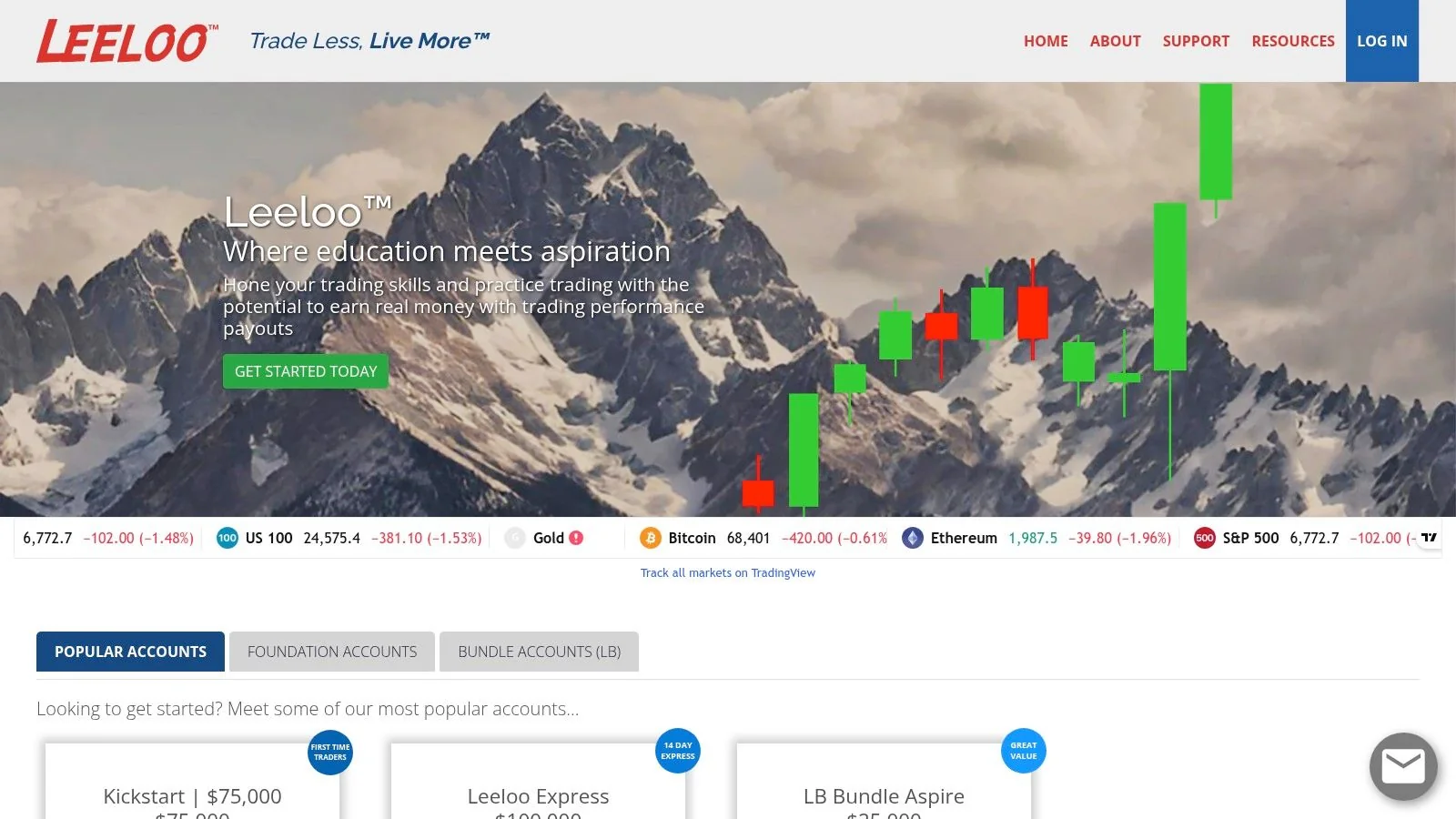
Leeloo Trading has carved out a distinct niche by offering a wide variety of evaluation types, including unique options designed for traders who prioritize payout speed and rule flexibility. For those looking for Apex Trader Funding alternatives that offer a different approach to risk parameters and payout schedules, Leeloo presents a compelling model. Its “Turbo” accounts, in particular, cater to traders who aim to get funded and paid quickly, often with less restrictive rules like the absence of a daily loss limit.
The firm’s philosophy appears to center on providing choice, allowing traders to select an evaluation that best matches their trading style, risk tolerance, and payout frequency goals. This contrasts with firms that offer a more standardized, one-size-fits-all path. Leeloo is also known for its trailing drawdown that can “lock” in place after reaching certain profit milestones, a feature that significantly reduces the psychological pressure of managing a floating drawdown.
Key Features and Structure
Leeloo’s main attraction is its diverse menu of evaluation accounts, each with different rules and objectives. The Turbo accounts are built for speed, while other options provide different balances of rules and profit potential. This structure allows traders to self-select the environment they believe they can succeed in.
- Diverse Account Menu: Leeloo offers several account types, including Foundation, Entry, Weekly, and the popular Turbo accounts, each with its own specific rules on trading days, profit targets, and drawdown.
- Turbo Account Benefits: These accounts often feature a $0 activation fee upon qualification and are designed for fast payouts. Some Turbo plans also remove the daily loss limit, giving traders more intra-day flexibility.
- Trailing Drawdown Lock: On certain Performance Accounts, the trailing drawdown stops trailing and locks at the initial starting balance once the account reaches a specific profit threshold. This removes the risk of a winning streak being erased by a subsequent drawdown.
- Copy-Trading Allowance: Leeloo permits copy trading across multiple accounts under the same user login, a feature that appeals to traders managing several accounts simultaneously to diversify risk.
Who is Leeloo Trading Best For?
Leeloo is best suited for traders who want more control over their evaluation conditions and payout frequency. The Turbo accounts are ideal for confident traders who can hit profit targets quickly and prefer to take smaller, more regular payouts. The trailing drawdown lock feature also makes it a strong candidate for traders who have previously struggled with the pressure of a perpetually trailing stop, as it provides a clear psychological and financial safety net once a profit buffer is built.
Expert Insight: The Turbo account model, with its payout caps and account closure after a set number of withdrawals, is a trade-off. It’s designed for generating consistent, smaller streams of income rather than one massive home run. Traders should read the specific rules for each account type carefully, as policies like the “no flipping” rule can impact strategies that rely on quick, large-tick scalps.
Pros and Cons of Leeloo Trading
| Pros | Cons |
|---|---|
| No daily loss limit on certain account types offers more flexibility. | Payout caps on Turbo accounts limit large, single withdrawals. |
| Trailing drawdown lock reduces risk after reaching profit milestones. | Account may be closed after a fixed number of Turbo payouts. |
| Turbo accounts can offer $0 activation fees and fast payout cycles. | Rules like the “no flipping” policy require careful study. |
| Large community and extensive knowledge base available for new traders. | Public reviews are mixed, and policies can change. |
Website: https://www.leelootrading.com/
4. OneUp Trader: Flexible Entry Costs and a Focus on Consistency
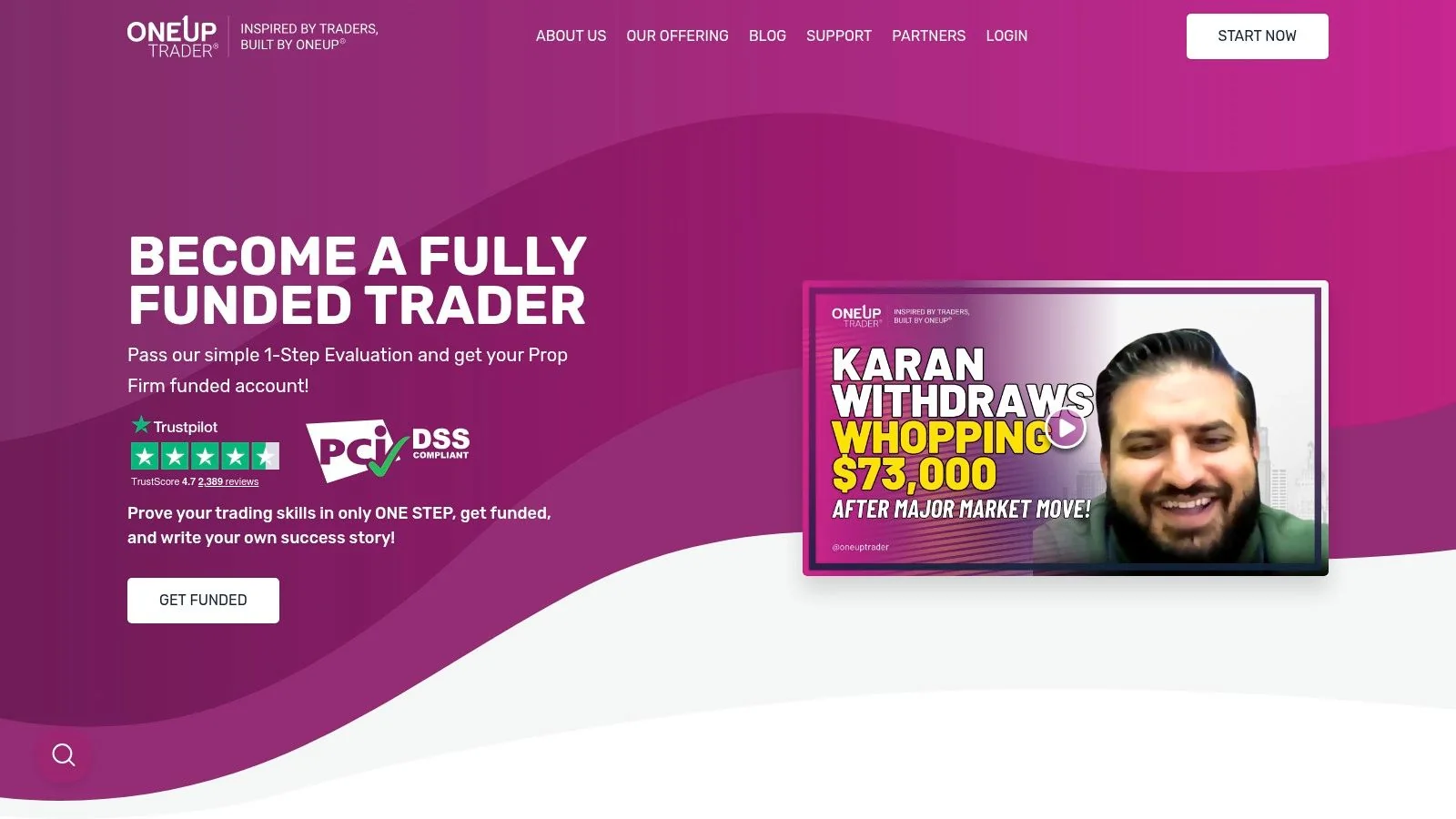
OneUp Trader presents an attractive proposition for traders seeking Apex Trader Funding alternatives that lower the initial financial barrier to entry. Its standout feature is a flexible payment option that allows traders to start an evaluation for 50% of the standard fee, paying the remainder only after successfully passing. This model, combined with a simple one-step evaluation process, makes it a compelling choice for those who are confident in their skills but want to manage upfront costs.
The firm is known for its straightforward rules and fast payout processing, aiming to remove common friction points for funded traders. While it uses a trailing drawdown, it also implements a “Consistency Rule” which requires traders to demonstrate balanced profitability. This rule is designed to prevent a single lucky day from carrying a trader through the evaluation, encouraging more stable and repeatable performance.
Key Features and Structure
OneUp Trader’s model is built around a single-step evaluation with clear profit targets and drawdown limits. The inclusion of the Consistency Rule adds an extra layer of challenge that rewards methodical traders over those who rely on volatile, all-or-nothing strategies.
- One-Step Evaluation: Pass a single evaluation period by hitting the profit target without violating the drawdown or daily loss limit rules.
- 50% to Start Payment Option: Traders can pay half the evaluation fee upfront and the other half only after passing. This reduces the initial financial commitment significantly.
- Consistency Rule: This rule dictates that no single trading day can account for more than 50% of your total profits. It encourages sustained performance over a minimum of 15 trading days.
- Fast Payouts and No Data Fees: OneUp Trader claims to offer same-day payout processing and states that funded traders do not pay for market data fees, which can be a meaningful cost saving.
Who is OneUp Trader Best For?
OneUp Trader is best suited for disciplined traders who produce steady, consistent returns and can comfortably operate within the parameters of the Consistency Rule. The 50% upfront payment option is a major draw for traders who are budget-conscious or wish to test the waters without a large initial investment. It is an excellent fit for those who prioritize quick access to profits and want to avoid hidden costs like monthly data fees in their funded account.
Expert Insight: The Consistency Rule can be a double-edged sword. While it filters for sustainable strategies, it can penalize traders who have an exceptionally good day early in their evaluation. It’s wise to track your best day’s P&L as a percentage of your total profit to ensure you don’t accidentally violate this rule.
Pros and Cons of OneUp Trader
| Pros | Cons |
|---|---|
| Reduced upfront cost with the 50% payment option. | Consistency Rule adds complexity and can be restrictive for some trading styles. |
| Claims of same-day payout processing and no data fees. | The trailing drawdown can be challenging for traders who experience early drawdowns. |
| Simple one-step evaluation process. | Reset fees are required to try again after a rule violation. |
| Active help center and clearly documented rules. | Promotional offers and specific terms can change; always verify on the website. |
Website: https://www.oneuptrader.com/
5. Elite Trader Funding (ETF): Maximum Flexibility with Multiple Evaluation Paths
Elite Trader Funding (ETF) has established itself as a strong contender in the prop firm space by offering a broad menu of evaluation types. For traders seeking Apex Trader Funding alternatives that cater to specific trading styles and risk management approaches, ETF’s flexibility is its main draw. The firm gives traders the power to choose their own evaluation structure, from traditional trailing drawdowns to less common end-of-day and static options.
This “a la carte” approach allows traders to align an evaluation’s rules with their personal strategy, rather than forcing their strategy to fit a single, rigid set of rules. Recent policy updates from late 2025 regarding their SIM-to-LIVE pathway have added more clarity around payout expectations and how to scale with multiple accounts. This makes ETF a noteworthy option for those who plan their growth trajectory in advance.
Key Features and Structure
ETF’s core strength is its variety of evaluation models, each designed for a different type of trader. This includes one-step evaluations with trailing, end-of-day, or static drawdowns, as well as expedited “Fast Track” accounts. This structure ensures nearly every trading methodology has a suitable path to funding.
- Multiple Evaluation Types: Traders can select from evaluations with trailing drawdowns (which move with your account balance), end-of-day (EOD) drawdowns (calculated once daily), and static drawdowns (which never move).
- Fast Track Accounts: These evaluations offer smaller profit targets and quicker access to funding, ideal for confident traders who want to get started quickly.
- Documented SIM-to-LIVE Pathway: ETF has published clearer policies on its SIM-to-LIVE transition, including caps on the number of SIM accounts a trader can hold and the total amount they can withdraw before moving to a full Live account. This helps traders plan their scaling strategy.
- Frequent Promotions: The firm is well-known for offering significant discounts and promotional pricing, often through its partners, making its evaluations highly accessible from a cost perspective.
Who is Elite Trader Funding Best For?
ETF is best suited for traders who have a defined strategy and know exactly what kind of risk parameters work for them. If your strategy is incompatible with a standard trailing drawdown, ETF’s EOD or static drawdown options provide a viable solution. It’s also an excellent choice for budget-conscious traders who are patient enough to wait for one of the firm’s frequent promotional deals.
Expert Insight: The introduction of SIM account caps is a critical detail. Traders who aim to generate significant income purely from multiple evaluation accounts must now plan for the transition to a Live account. This policy encourages a focus on long-term, sustainable trading over churning evaluation passes for quick payouts.
Pros and Cons of Elite Trader Funding
| Pros | Cons |
|---|---|
| High flexibility with multiple evaluation types to fit any strategy. | Rules and account types can change, requiring traders to stay informed. |
| Competitive entry prices, especially during promotional periods. | SIM payout and account caps require planning for the SIM-to-LIVE transition. |
| Clearer SIM-to-LIVE transition policy as of late 2025. | The variety of options could be overwhelming for absolute beginners. |
| Offers static and EOD drawdown options, which are rare. | Some traders may prefer firms with a simpler, single-path structure. |
Website: https://www.elitetraderfunding.com/
6. UProfit Trader: The Home for Disciplined Intraday Traders
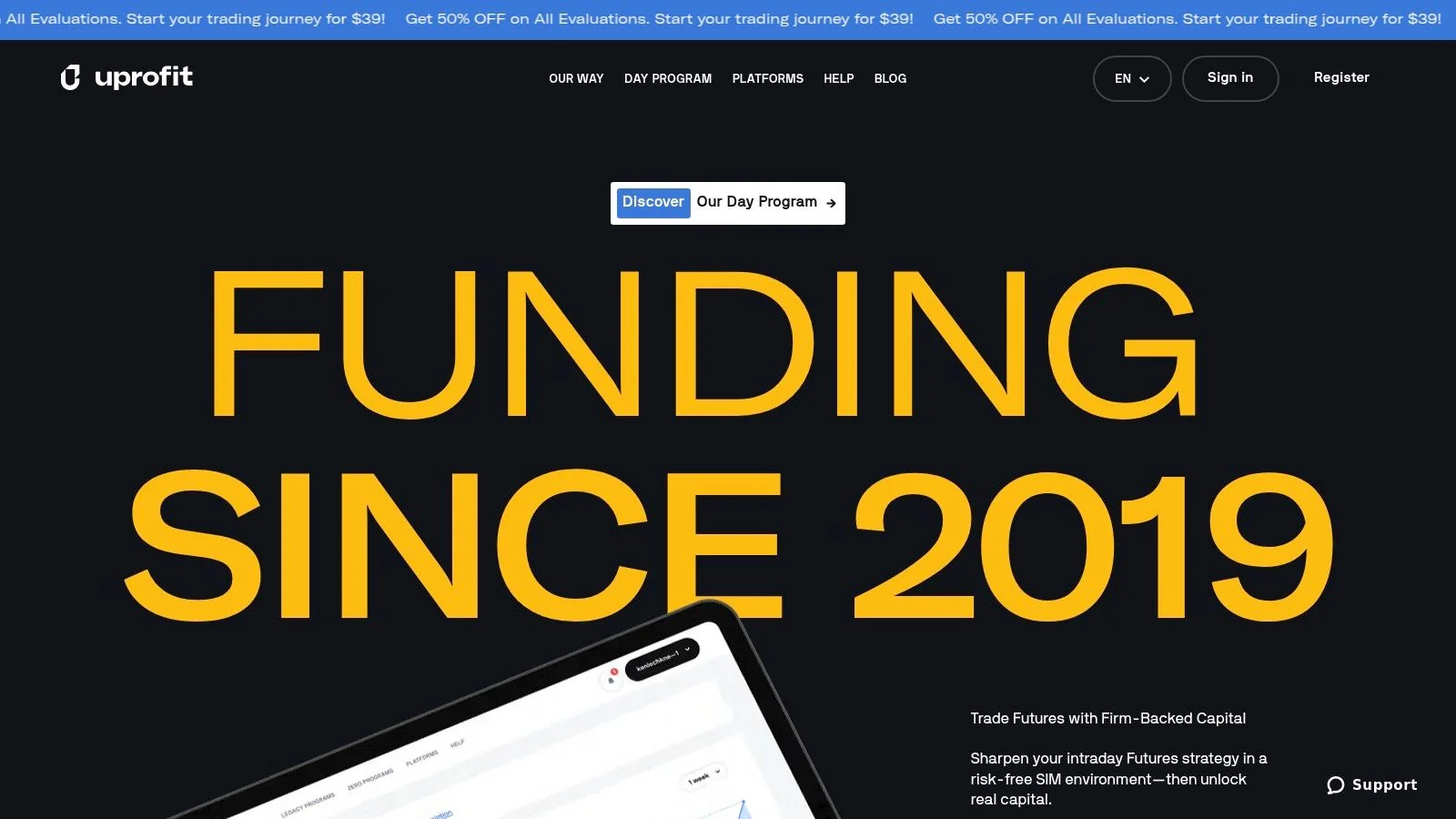
UProfit Trader carves out a specific niche by focusing on structured, intraday-only trading with explicit scaling rules. For traders seeking Apex Trader Funding alternatives that reward discipline and provide a clear, milestone-based career path, UProfit offers a compelling framework. Its model is built on preventing common risk management failures, such as over-leveraging and holding positions through volatile overnight sessions.
This focus on strict intraday risk controls means all positions must be flat before a set daily cutoff time, making it ideal for pure day traders. UProfit’s strength lies in its transparency, particularly with its well-documented scaling ladders and extensive help center. This removes the guesswork often associated with contract limits and account growth, appealing to traders who prefer a predictable and systematic approach to scaling their operations.
Key Features and Structure
UProfit’s evaluation programs guide traders toward a Live Account with a methodical scaling plan. The entire system is designed to enforce disciplined sizing and prevent traders from accidentally violating rules as their account balance grows. This structure is especially beneficial for those developing consistency.
- Explicit Contract Scaling: UProfit links your maximum contract size directly to your account balance. For example, on a $50K account, you can only trade more contracts after your balance surpasses specific profit milestones. This prevents premature and risky size increases.
- Intraday-Only (Day) Accounts: A core feature is the requirement to close all positions before the market close. This eliminates overnight and swing trading risk, forcing a disciplined day trading strategy.
- Comprehensive Rule Documentation: The firm provides a robust help center that clearly outlines its “Safe Custody” policy, scaling rules, and other operational procedures. This reduces ambiguity and helps traders understand exactly what is expected.
- One-Step Evaluation: UProfit uses a simple one-step evaluation process, allowing traders to get funded after meeting the profit target and rule criteria in a single phase.
Who is UProfit Trader Best For?
UProfit is an excellent choice for day traders who thrive within a structured environment and want to eliminate the temptation of holding trades overnight. The clear scaling ladder is perfect for traders who have previously struggled with inconsistent position sizing. If you value a system that automatically enforces good risk management habits and provides a clear roadmap for growth, UProfit’s model is built for you.
Expert Insight: The strict contract scaling at UProfit is a double-edged sword. It’s a fantastic training tool for building discipline. However, a breach is unforgiving and results in an account reset. Traders must actively monitor their account balance to ensure they don’t accidentally size up before hitting the required profit milestone.
Pros and Cons of UProfit Trader
| Pros | Cons |
|---|---|
| Very clear scaling ladders prevent accidental oversizing. | Day accounts prohibit overnight/swing trades, limiting strategy options. |
| Intraday risk controls are well-suited for disciplined day traders. | Scaling breaches are strict and trigger account resets. |
| Active and detailed documentation clarifies rules and operations. | Promotions and pricing can vary, requiring careful review at checkout. |
| Simple one-step evaluation process for faster funding. | Less flexibility compared to firms that allow holding trades longer. |
Website: https://uprofit.com/
Apex Trader Funding Alternatives: 6-Platform Comparison
| Item | Implementation complexity | Resource requirements | Expected outcomes | Ideal use cases | Key advantages |
|---|---|---|---|---|---|
| Topstep | Moderate — multi‑step evaluation + unlocks | Monthly fee or activation, platform/data access, broker integration | Funded live accounts with unlock milestones and clear fee tables | Traders seeking mature program with broker/platform integrations | Long history, transparent fees, detailed live‑account rules |
| Earn2Trade (TCP / Gauntlet) | Moderate — structured paths (TCP) or fast Gauntlet | Evaluation/course fees, time to progress, education materials | Funding up to $200K/$400K (scaling); education support; 80/20 split | Learners wanting structured growth or faster routes to funding | Education‑first approach, free TCP resets, published pass stats |
| Leeloo Trading | Moderate–High — varied evaluations and Turbo options | Eval fees, active trading cadence, monitor payout rules | Rapid small payouts possible; trailing drawdown behaviors | Active traders seeking fast payouts and flexible evaluations | Turbo accounts, no daily loss on some plans, trailing drawdown locks |
| OneUp Trader | Low–Moderate — one‑step eval with consistency rule | Eval fee with 50%‑to‑start option, data/platform access | Funded account on pass; fast payout processing claimed | Cost‑sensitive traders; those preferring simple, fast evaluations | 50% upfront option, fast payouts, frequent promotions |
| Elite Trader Funding (ETF) | Moderate — multiple eval types and SIM→LIVE path | Eval fees, planning for SIM payout/account caps, promos | Flexible funding routes; SIM payout/account caps to manage | Traders needing specific eval types or scaling multiple accounts | Multiple evaluation structures, clearer SIM→LIVE policies |
| UProfit Trader (UProfit) | Moderate — strict milestone and scaling rules | Eval fees, disciplined contract sizing, intraday data | Milestone‑based contract scaling; intraday‑only account behavior | Disciplined day traders who avoid overnight/swing positions | Clear scaling ladders, strong intraday risk controls |
Your Action Plan: Choosing the Right Alternative for Your Trading Career
The proprietary trading firm space is crowded, but finding the right partner isn't about chasing the biggest account size or the steepest discount. As we've detailed, a world of excellent Apex Trader Funding alternatives exists, each offering a distinct pathway for traders. Your task is to move beyond the marketing hype and align a firm’s structure with your personal trading methodology.
The journey from evaluating options to getting funded requires a clear-eyed assessment of your own strengths and weaknesses. The "best" firm is simply the one whose rulebook best complements your existing strategy, not one that forces you to change your entire approach.
A Decision Framework: From Information to Action
You've absorbed a lot of information on Topstep, Earn2Trade, Leeloo Trading, and others. Now, it's time to turn that knowledge into a concrete decision. This isn't a lottery ticket; it's a business investment. Use the following step-by-step checklist to systematically narrow down your options and make a calculated choice.
- Define Your Trading Identity: Are you a scalper grabbing a few ticks at a time, a day trader holding for several hours, or a swing trader holding overnight? Your answer is the most critical filter. Swing traders, for example, must immediately disqualify firms that don't allow overnight or weekend positions.
- Analyze Your Drawdown Profile: Be brutally honest about your trading performance. Does your equity curve have deep, sharp pullbacks followed by strong recoveries? A static or End-of-Day drawdown (like those offered by Elite Trader Funding) might be more forgiving. If you have a smooth, consistent equity curve with minimal drawdowns, a trailing drawdown (common with Apex and others) might be perfectly acceptable and offer other benefits.
- Clarify Your Payout Goals: What does success look like for you? If your primary goal is to generate frequent, regular income to supplement or replace a salary, a firm with a simple, fast payout schedule like Leeloo Trading or UProfit could be ideal. If you're playing the long game and want structured growth, a larger capital base, and a more established, career-oriented path, the programs at Topstep or Earn2Trade's Trader Career Path might be a better fit.
- Audit Your Platform and Tools: Your trading platform is your cockpit. If you are a die-hard NinjaTrader user, most firms will suit you. However, if you prefer platforms like Rithmic R|Trader Pro, Tradovate, or TradingView, your list of viable Apex Trader Funding alternatives narrows considerably. Don't compromise on the tools you need to execute your strategy effectively.
- Run the Numbers: This is the most overlooked step. Don't just guess; calculate. Take your top two or three choices and model a worst-case scenario. Use a tool like the FinSeeds Drawdown Calculator to input your average losing streak and loss size. See exactly how a trailing vs. an EOD drawdown would impact your account. This simple exercise can reveal which firm's risk parameters give you the breathing room you need to trade comfortably.
By following this structured approach, you shift from hoping you pass an evaluation to strategically selecting a business partner. The power is in your hands to perform the due diligence required to find a funding partner that supports, rather than hinders, your path to consistent profitability. The right prop firm for your trading career is out there, and now you have the blueprint to find it.
Ready to stress-test your strategy against different prop firm rules before you spend a dime on an evaluation? FinSeeds offers a powerful suite of trading calculators, including the crucial Drawdown Calculator, that lets you model how your performance would fare under various rulesets from firms like those mentioned in this guide. Use the free tools at FinSeeds to make an informed, data-driven decision and choose the funding path that's right for you.
Keep reading