
Prop Firm Reviews
6 Best Take Profit Trader Alternatives for Futures Trading in 2026
 by Anthony TranUpdated on Mar 8, 2026
- Min read
- 18
- Sections
- 08
Disclaimer: Educational content based on personal experience, not financial advice. Futures trading involves substantial risk. Read full disclaimer
In this article
Take Profit Trader has established a significant presence in the proprietary trading space, offering a clear path for futures traders to access funded accounts. Its straightforward rules and evaluation process attract many newcomers and experienced traders alike. However, the world of prop firms is not a one-size-fits-all environment. What works perfectly for one trader's strategy, risk tolerance, and trading style might be a restrictive bottleneck for another.
This is where exploring Take Profit Trader alternatives becomes crucial. Your ideal firm might offer different drawdown rules, more flexible evaluation parameters, a higher profit split, or support for a specific trading platform that better suits your needs. The challenge is sifting through the dozens of options, each with its own unique set of promises and pitfalls.
This guide is built to solve that problem. We will directly compare leading prop firms, breaking down the critical details that matter most to a trader's success and bottom line. You will find a clear, side-by-side analysis of key rules, costs, and payout structures. Each section provides a concise summary, pros and cons, and direct links to help you make an informed decision without wading through marketing jargon. Whether you're seeking your first funded account or looking for a firm that better aligns with your established strategy, this roundup will provide the clarity needed to choose your next trading partner.
1. Topstep
For traders seeking a well-established firm with a long history and a clear, structured evaluation process, Topstep presents a strong alternative. Founded in 2012 and based in Chicago, Topstep is one of the pioneers in the prop trading space, particularly for futures. Their reputation is built on a straightforward, single-phase evaluation called the Trading Combine, designed to test a trader's ability to manage risk and generate profit within a defined ruleset.

Unlike the often complex, multi-stage evaluations found elsewhere, Topstep’s one-step process simplifies the path to a funded account. Traders must hit a profit target without violating key risk parameters, such as the Daily Loss Limit and a Maximum Loss Limit, which trails at the end of the day during the evaluation. This structure is particularly helpful for traders who appreciate clear boundaries and want to focus purely on their trading strategy without juggling different rules for multiple phases.
Key Features and Evaluation Structure
Topstep’s model is built around its Trading Combine. The firm offers several account sizes, each with a corresponding monthly fee. A key distinction is their pricing structure: traders can choose a standard path with a lower monthly fee that requires a one-time activation fee upon passing, or a higher monthly fee path that has no activation fee.
- Evaluation: Single-phase Trading Combine.
- Profit Target: Varies by account size (e.g., $3,000 for a $50K account).
- Daily Loss Limit: A hard stop calculated from the previous day's end-of-day balance.
- Maximum Loss Limit: A trailing drawdown that updates at the end of each profitable trading day during the Combine.
- Consistency Target: Traders must adhere to a rule where their best trading day cannot account for more than 50% of their total profits.
- Platform: As of mid-2024, new Trading Combines must be conducted on Topstep’s proprietary platform, TopstepX. While this may limit choice for some, it provides an integrated experience with free Level 1 data.
Who is Topstep Best For?
Topstep stands out for its extensive documentation and transparent rules. Their help center is exceptionally detailed, providing clear answers on everything from rule calculations to payout procedures. This makes it an excellent choice for traders who are new to prop firms and want to avoid ambiguity.
Trader Insight: The end-of-day trailing drawdown in the evaluation is a significant advantage over real-time trailing drawdowns. It allows for intraday profits to create a buffer without the risk of the floor immediately rising and stopping you out.
However, the rigid rule structure, particularly the Consistency Target, can be a hurdle for traders who employ a high-risk, high-reward strategy or have infrequent but large winning days. If you prefer more flexibility or wish to use platforms like NinjaTrader or Tradovate during your evaluation, you might want to explore other options. For a deeper analysis of how Topstep stacks up against other firms, you can find more information on top alternatives to Topstep.
Website: https://www.topstep.com
2. Apex Trader Funding
For traders who value flexibility, the ability to manage multiple accounts, and frequent promotional opportunities, Apex Trader Funding is a major player and a compelling take profit trader alternative. This U.S.-based firm has gained significant popularity, especially within the futures trading community, by offering a wide array of account sizes and a one-step evaluation process. Apex is well-known for its frequent deep discounts on evaluation fees, making it an accessible entry point for many traders.
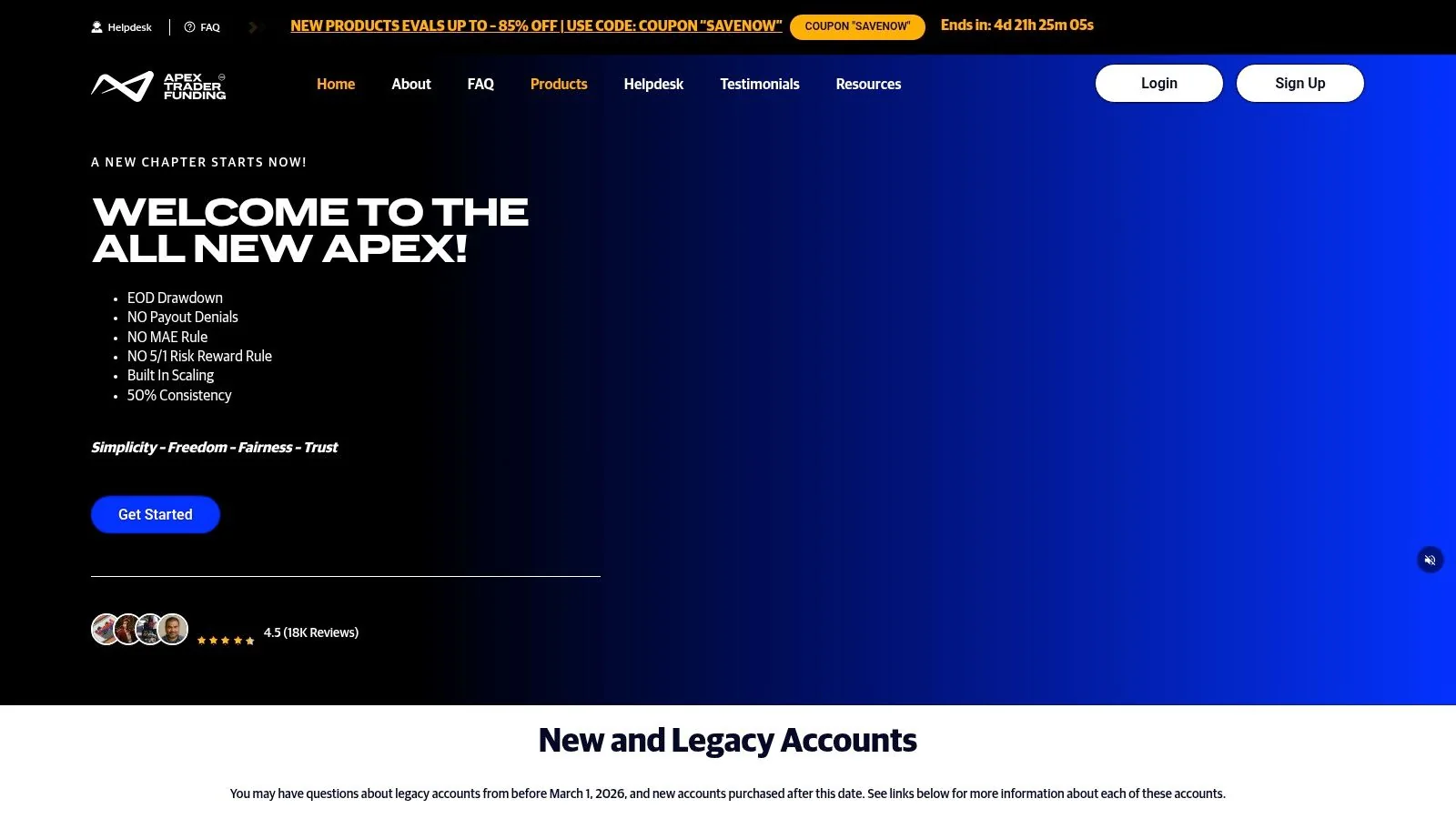
The firm's core appeal lies in its straightforward, single-phase evaluation and the unique ability for traders to operate up to 20 Performance Accounts (funded accounts) simultaneously. This multi-account strategy allows successful traders to scale their operations significantly. Evaluation access is sold for a fixed period rather than a recurring monthly subscription, which can be cost-effective for traders confident in their ability to pass quickly.
Key Features and Evaluation Structure
Apex’s model is built around passing a single evaluation to gain access to a Performance Account (PA). While the rules have evolved, the core structure remains consistent and is designed to identify profitable traders who can manage risk according to the firm's parameters.
- Evaluation: Single-phase evaluation with a one-time fee per attempt (often heavily discounted).
- Profit Split: Historically 100% of the first $25,000 in profits per account, and 90% thereafter. Payouts are processed on a set schedule, typically twice a month.
- Account Flexibility: Traders are permitted to have up to 20 Performance Accounts, a key differentiator in the industry.
- Drawdown: Utilizes a trailing threshold that updates in real-time based on your unrealized peak balance during the trading day. End-of-day (EOD) drawdown plans are also available.
- Trading Hours: Allows trading during most market hours, including major news events, giving traders more opportunities.
- Platform: Primarily supports NinjaTrader and Tradovate, offering traders a choice of industry-standard platforms.
Who is Apex Trader Funding Best For?
Apex Trader Funding is an excellent fit for confident futures traders who want to scale their funded capital aggressively and take advantage of promotional pricing. The ability to run multiple accounts is a massive draw for those looking to maximize their earning potential. Its large community and active online presence also mean there is a wealth of shared knowledge and support available.
Trader Insight: The real-time trailing drawdown is a critical rule to master. Unlike end-of-day drawdowns, this type of drawdown will rise with any open profit. Traders must be disciplined and avoid letting large winning trades turn into losing ones, as this can quickly breach the threshold.
However, the firm’s rules and payout structures can change, requiring traders to stay updated by monitoring the help desk and official communications. The addition of consistency rules and Maximum Allowable Equity (MAE) constraints on some accounts can also present a challenge for highly aggressive or inconsistent trading styles. If you are exploring how Apex compares to other firms with different rule sets, you can find more information on top alternatives to Apex Trader Funding.
Website: https://apextraderfunding.com
3. OneUp Trader
For traders who value a straightforward evaluation and a lower initial financial commitment, OneUp Trader offers a compelling alternative. This firm is known for its single-phase evaluation and a unique 50% upfront pricing model, which significantly reduces the initial cost to start a challenge. This structure allows traders to prove their skills without a large upfront investment, paying the second half of the fee only after successfully passing the evaluation.

Similar to other leading firms, OneUp Trader focuses on a one-step process, removing the complexity of multi-stage challenges. This approach is ideal for traders who want to focus on a single set of rules from start to finish. With account sizes ranging from $25,000 to $250,000 and clear dashboard analytics provided during the evaluation, the firm aims for transparency and a user-friendly experience.
Key Features and Evaluation Structure
OneUp Trader’s model is built around a single-phase evaluation with clear, attainable objectives. The firm offers two main paths: a Standard evaluation and an Express option, which differ in minimum trading days and cost structure, giving traders flexibility based on their timeline and budget.
- Evaluation: Single-phase evaluation with a clear profit target.
- Pricing Model: A standout 50% split-payment option lowers the initial fee. The remaining 50% is due only upon passing the evaluation.
- Minimum Trading Days: Varies by account type, with Standard accounts requiring 10 days and some Express accounts as few as 5 days.
- Account Sizes: Options range from $25K to $250K, accommodating different risk appetites and trading styles.
- Drawdown: Utilizes a trailing drawdown that updates intraday based on your account's peak balance.
- Transparency: The firm provides regular public product updates and detailed dashboard analytics for traders to track their progress.
Who is OneUp Trader Best For?
OneUp Trader is an excellent choice for traders who are confident in their abilities but cautious about high upfront costs. The split-payment model is a significant advantage, making it one of the more accessible take profit trader alternatives. The clear site navigation and regular updates also create a sense of trust and transparency.
Trader Insight: The 50% upfront payment model is a game-changer for budget-conscious traders. It effectively cuts your initial risk in half, as you only pay the full price if you succeed. This can relieve some of the psychological pressure associated with evaluation fees.
However, traders should be aware that promotions and pricing can vary and are not always centralized on one page. Additionally, live funded accounts are handled by third-party funding partners, which may introduce geographic restrictions for some traders. If you prioritize a low initial entry fee and a simple, one-step process, OneUp Trader is a strong contender.
Website: https://www.oneuptrader.com
4. Earn2Trade
For traders who value structured learning alongside their funding journey, Earn2Trade offers a compelling education-first approach. Founded with the mission to help traders develop sound habits before they risk capital, Earn2Trade provides distinct evaluation paths backed by extensive educational resources. This makes it a strong alternative for those who want to build a solid foundation while pursuing a funded account.

Unlike firms focused solely on the evaluation, Earn2Trade integrates a comprehensive educational curriculum. Their model is built around two primary programs: the Trader Career Path and the Gauntlet Mini. Both are designed to test risk management and profitability, but they cater to different trader goals, one focusing on a scaling plan and the other on a one-time evaluation. This focus on education and clear progression makes it a prime candidate among Take Profit Trader alternatives.
Key Features and Evaluation Structure
Earn2Trade’s programs provide a clear roadmap from evaluation to a funded account with one of their partner firms, such as Helios Trading Partners. The rules are documented in great detail, helping traders understand exactly what is expected of them.
- Evaluation: Multiple paths including the Trader Career Path (TCP) and the Gauntlet Mini. The TCP is a one-step evaluation with a scaling plan, while the Gauntlet Mini is a more traditional single-phase challenge.
- Profit Target: Varies by account size and program.
- Daily Loss Limit: A fixed amount that does not trail during the day.
- Maximum Loss Limit: An end-of-day trailing drawdown, which provides intraday breathing room.
- Consistency Rule: Similar to other firms, Earn2Trade requires that a trader's best day does not account for an excessive percentage of their total profits.
- Platform: Supports popular platforms like NinjaTrader and Tradovate, offering traders flexibility in their choice of tools.
Who is Earn2Trade Best For?
Earn2Trade is an excellent choice for beginner and developing traders who want more than just a funding challenge. The extensive library of educational materials, from beginner courses to advanced strategy webinars, provides significant value beyond the evaluation itself. The clear rule documentation and supportive help center are also major benefits for anyone new to the proprietary trading space.
Trader Insight: The end-of-day drawdown is a key advantage. It means your intraday open profits won't raise your stop-out level in real time, which is a major point of frustration for traders at firms that use live-trailing drawdowns. This allows for more aggressive intraday management without immediate penalty.
However, the subscription-based pricing for the evaluations can become costly if it takes a trader several months to pass. Furthermore, the firm's strict adherence to rules, such as considering both open and closed equity for intraday drawdown calculations, can feel demanding for some trading styles. If you are confident in your strategy and primarily seeking the lowest-cost path to funding without educational extras, you might consider other options.
Website: https://www.earn2trade.com
5. Leeloo Trading
For traders who appreciate flexibility and a variety of evaluation models, Leeloo Trading offers a compelling alternative to Take Profit Trader. Founded with a trader-centric approach, Leeloo is known for its diverse account types, frequent promotional pricing, and a clear, well-documented rule set. The firm caters to futures traders by providing multiple paths to funding, allowing individuals to choose an account style that best aligns with their trading strategy and risk tolerance.
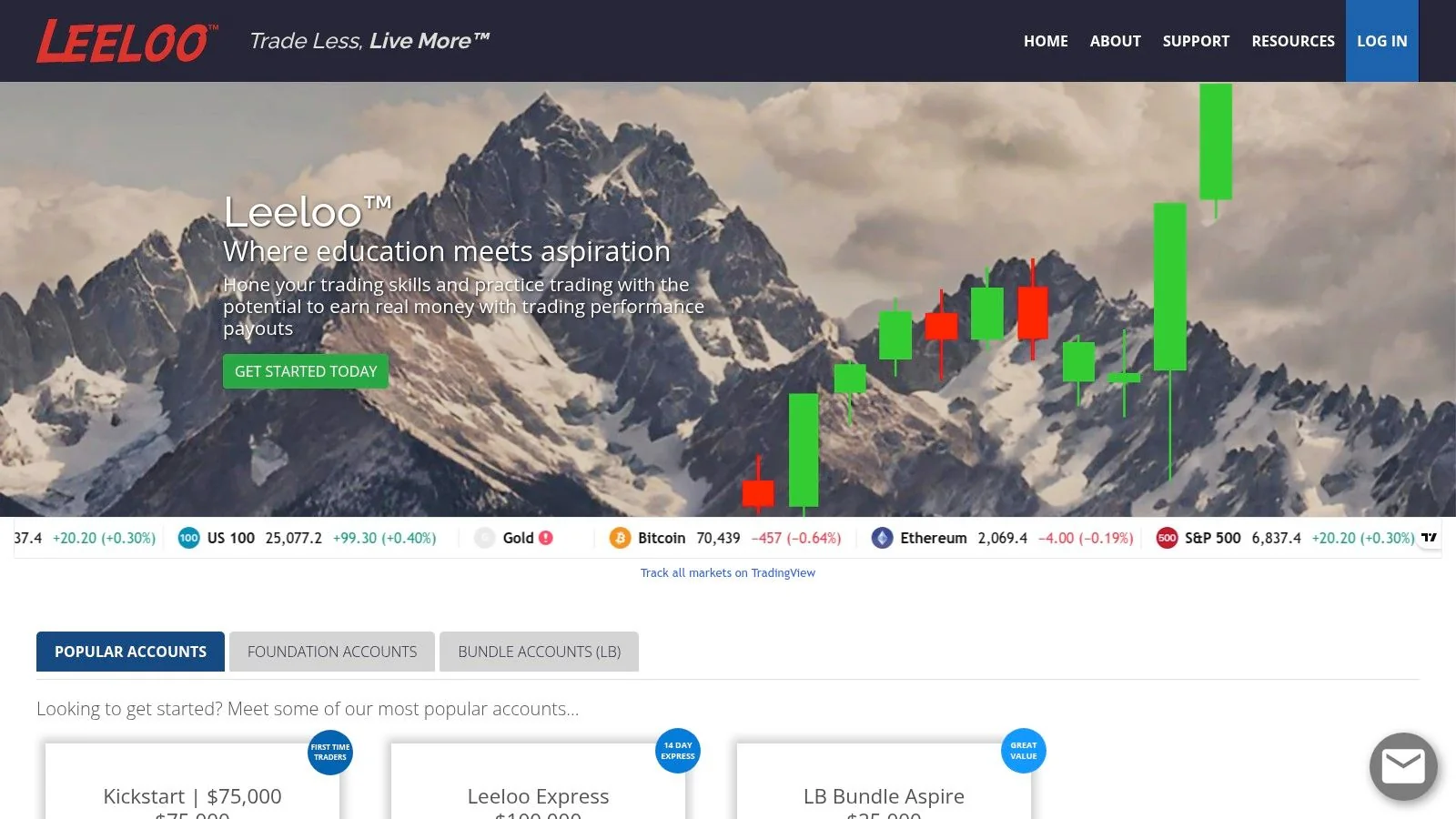
One of Leeloo’s standout offerings is its selection of "Turbo" accounts. These subscription-based evaluations remove the one-time activation fee common at other firms, replacing it with a fixed monthly cost. This model can be more cost-effective for traders who are confident in passing quickly or who prefer a predictable, recurring expense. The firm’s emphasis on transparency is also a major draw; their support portal thoroughly documents plan mechanics, payout schedules, and drawdown rules, reducing ambiguity for traders.
Key Features and Evaluation Structure
Leeloo’s evaluation programs are designed to be straightforward, typically involving a single phase to reach a funded Performance Account. The rules are consistent with industry standards, focusing on hitting a profit target without breaching loss limits. A key advantage is that traders can hold unlimited evaluation accounts simultaneously, which allows for testing different strategies or having backup attempts ready.
- Evaluation: Single-phase evaluation to reach a Performance Account.
- Account Types: Offers various models, including "Leeloo" (one-time fee), "Turbo" (monthly subscription, no activation fee), and "Accelerator" (trailing drawdown).
- Profit Split: Up to 90% for the trader, with the first $12,500 being 100% yours.
- Maximum Loss Limit: Typically a trailing drawdown that updates intraday on most account types.
- Payout Caps: Some account types, like the Turbo, have a maximum total payout limit and may close after a certain number of withdrawals.
- Platforms: Supports major platforms like NinjaTrader (license included for Performance Accounts), Tradovate, and others.
Who is Leeloo Trading Best For?
Leeloo Trading is an excellent choice for traders who value variety and clear documentation. Their extensive support articles provide detailed explanations of how each account works, making it easier to select the right fit and understand the rules before starting. The frequent promotions and competitive monthly pricing on Turbo accounts make it an attractive option for budget-conscious traders.
Trader Insight: The ability to have multiple evaluation accounts at once is a strategic advantage. It allows you to diversify your attempts or continue trading on one account if you make a mistake on another, without having to wait for a reset.
However, traders must pay close attention to the fine print. The payout caps and account closure rules on certain plans, like the Turbo accounts closing after the fifth payout, may not be suitable for those seeking a long-term, single-account career path. If your goal is an uncapped, long-term funded account, you may need to carefully compare Leeloo's different account types or consider other firms.
Website: https://www.leelootrading.com
6. UProfit Trader
For traders who prioritize transparent rules and a clear path to scaling their trading size, UProfit Trader offers a compelling model. This firm provides an evaluation-to-live trading pathway with a strong focus on platform flexibility and a structured contract-scaling plan. UProfit aims to build trader confidence by publishing pass-rate data and maintaining detailed, publicly accessible help center articles that clarify its rules and processes.
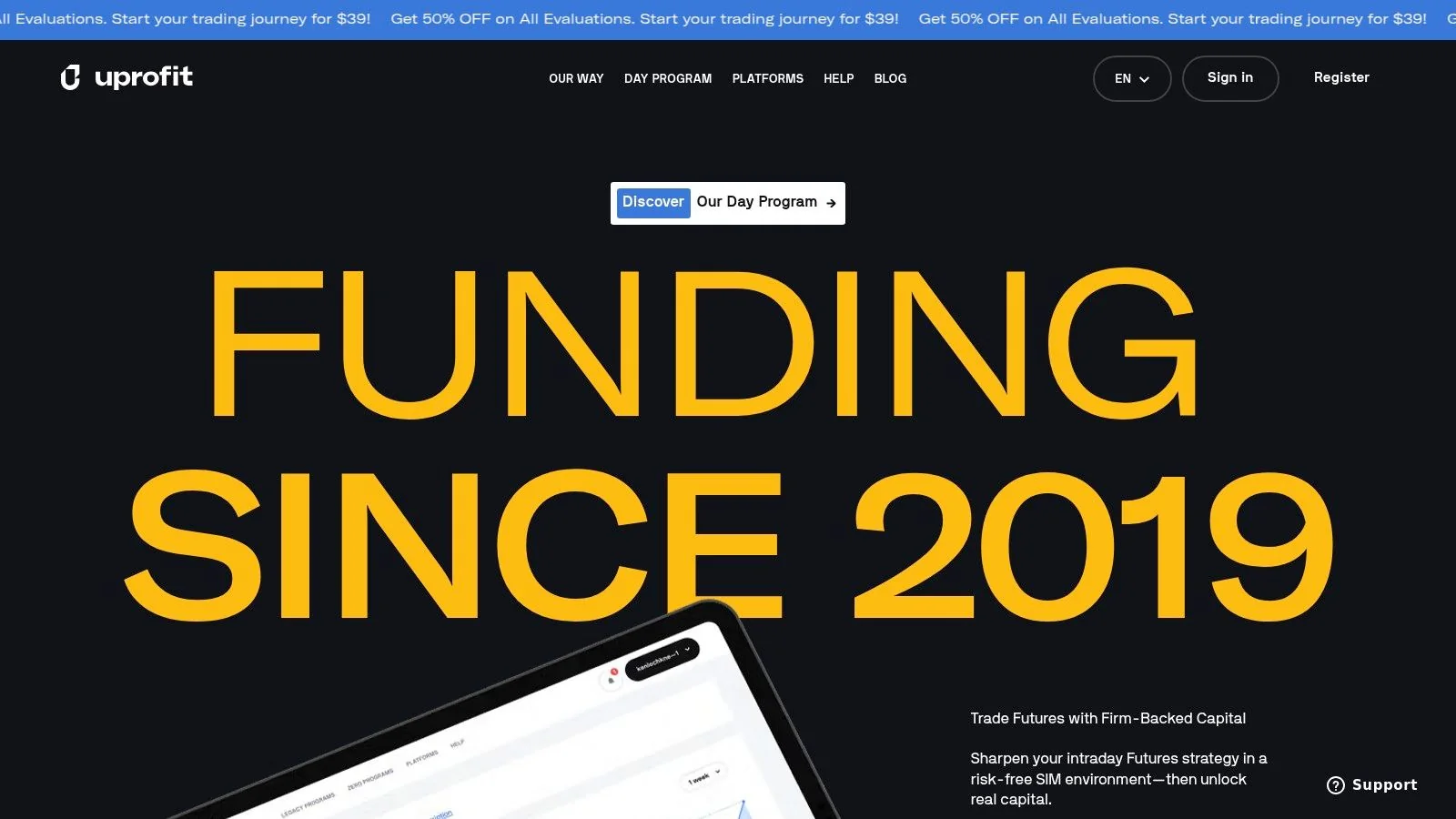
Unlike firms that can be opaque about their internal metrics, UProfit’s publication of pass-rate snapshots demonstrates a commitment to transparency. The core of their offering is a one-step evaluation designed to assess a trader's profitability and risk management. Upon passing, traders move to a "Live Account," where they can scale the number of contracts they trade based on their accumulated profits, offering a measurable growth trajectory.
Key Features and Evaluation Structure
UProfit’s evaluation is a straightforward, single-phase challenge. The firm provides several account sizes, each with its own monthly subscription fee, profit target, and drawdown limit. A major benefit is the end-of-day drawdown calculation, which prevents intraday gains from making a trader's risk limit dangerously tight during a session.
- Evaluation: Single-phase evaluation program.
- Profit Target: Varies based on the selected account size (e.g., $2,500 on a $50K account).
- Drawdown: An End-of-Day Trailing Drawdown that only updates at the close of a profitable trading day.
- Minimum Trading Days: Requires a minimum of 5 trading days to pass the evaluation.
- Platforms: Supports a wide range of platforms, including NinjaTrader, Rithmic R|Trader Pro, and TradingView, giving traders ample choice.
- Scaling Plan: Live accounts feature a clear contract scaling plan, allowing traders to increase their position size as their account balance grows.
Who is UProfit Trader Best For?
UProfit Trader is an excellent choice for traders who value clear, pre-defined rules and a visible path for advancement. The detailed help center, which covers everything from trading hours to reset rules, is particularly helpful for those who want to avoid surprises. The end-of-day drawdown is a significant advantage, making it a strong Take Profit Trader alternative for those who found real-time drawdowns restrictive.
Trader Insight: UProfit's scaling plan is a standout feature. It provides a concrete goalpost for traders, linking increased position size directly to performance. This removes the guesswork often associated with asking for more size at other firms.
However, traders should be aware that promotions, pricing, and specific program rules can change. It is always best practice to review the latest details on their website and in the help center before committing to an evaluation. While the rule structure is transparent, it is still strict, and traders who prefer more relaxed guidelines might look elsewhere.
Website: https://uprofit.com
Top 6 Take Profit Trader Alternatives Comparison
| Provider | Implementation complexity | Resource requirements | Expected outcomes | Ideal use cases | Key advantages |
|---|---|---|---|---|---|
| Topstep | Medium — structured single-phase evaluation | Monthly fee or path fee, TopstepX platform, market data | Potential funded futures account with disciplined risk rules | Traders seeking clear published rules and structured progression | Long track record, detailed help center, consistent risk framework |
| Apex Trader Funding | Medium — multiple account types, changing promos | Promo-driven fees, multiple account management, active monitoring | Funded accounts across many sizes, frequent promotional pricing | Traders wanting many funded-account options and sale pricing | Wide account variety, active community, frequent promotions |
| OneUp Trader | Medium — one-step evaluation with analytics | Split-payment pricing, evaluation dashboard, time commitment | Funded account access with lower upfront cost if passed | Cost-sensitive traders, those who value evaluation analytics | 50% split payment model, visible performance dashboard |
| Earn2Trade | Medium–High — education plus evaluations | Subscription for courses/evaluations, study time | Funded accounts via partners; strong educational foundation | Beginners needing structured learning and assessment | Extensive educational resources, clear partner-funding path |
| Leeloo Trading | Medium — turbo/performance options, promo-driven | Monthly subscriptions, possible NinjaTrader license, promotional timing | Funded/performance accounts; some payout caps/limits | Traders preferring monthly turbo plans or NinjaTrader inclusion | Clear plan documentation, competitive monthly pricing, frequent promos |
| UProfit Trader | Medium — evaluation → virtual live, scaling steps | Platform flexibility (TradingView/Rithmic), follow-up scaling milestones | Contract-scaling funded path with published pass-rate snapshots | Traders wanting platform choice and staged scaling | Transparent rules, contract-scaling guidance, platform flexibility |
Making Your Choice: A Framework for Selecting the Right Alternative
Navigating the world of proprietary trading firms can feel like sorting through a complex puzzle. We've explored a range of strong Take Profit Trader alternatives, each with distinct rules, benefits, and trade-offs. The right choice doesn't depend on which firm is objectively "best," but on which firm's structure aligns perfectly with your individual trading style, risk tolerance, and career goals. Moving from comparison to decision requires a personal framework.
The core insight from our analysis is that prop firms are not one-size-fits-all. A firm like Apex Trader Funding, with its single-step evaluation and lenient rules on trading during news events, appeals to aggressive, experienced traders. In contrast, a firm like Earn2Trade offers a more structured educational path, making it a better fit for disciplined traders who value mentorship and a clear progression. Your task is to match your personal trader profile to the firm's operational philosophy.
Creating Your Personal Decision Matrix
To move forward with clarity, avoid making a choice based on a single factor like the lowest entry fee or the highest profit split. Instead, build a simple decision matrix. List your top two or three firm choices and score them based on what matters most to you.
Consider these key factors and assign a weight to each:
- Drawdown Rules (Weight: High): Is it a trailing drawdown or an end-of-day calculation? A trailing drawdown can be unforgiving for traders who let winning trades pull back significantly. An end-of-day rule, offered by firms like UProfit, gives you more breathing room during market hours.
- Evaluation Structure (Weight: Medium-High): Do you prefer a single-step evaluation to get funded faster (like Apex or Leeloo), or does a two-step process (like Topstep) better suit your need to prove consistency? There's no right answer, only what works for your psychology.
- Scaling Plan (Weight: Medium): How clear and achievable is the path to managing more capital? A good scaling plan should be based on consistent profitability, not on unrealistic targets. This is your long-term growth engine within the firm.
- Platform & Data Fees (Weight: Low-Medium): Initial costs are a factor, but don't let a cheap entry fee blind you to expensive ongoing data or platform fees. Calculate the total monthly cost to maintain your access, especially before you become consistently profitable.
Key Takeaway: The most critical variable is the drawdown rule. A rule set that clashes with your natural trading tendencies will almost certainly lead to failure. Prioritize finding a firm whose risk parameters you can comfortably operate within day after day.
Actionable Next Steps: From Analysis to Action
You are now equipped with the information to make an educated choice. Here is a practical checklist to guide your final decision:
- Re-read the Rules: Go directly to the websites of your top two choices. Read their FAQ and rules pages yourself. Firm rules can change, so always verify the details we've discussed.
- Search for Community Feedback: Look for recent trader reviews on platforms like Reddit (r/FuturesTrading) or YouTube. Pay attention to comments about payout speed, customer support responsiveness, and any platform issues.
- Consider a Trial: If available, take a free trial. This is the best way to test the platform, data feed quality, and execution speed without risking any capital.
- Make Your Selection: Choose one firm and one account size. Commit to its rules and give it your full focus. Avoid the temptation to try multiple firms at once, as this can dilute your attention and lead to costly mistakes.
Ultimately, choosing a prop firm is the first step on a longer journey. The real work lies in disciplined execution, consistent risk management, and a commitment to continuous improvement. The Take Profit Trader alternatives we've examined all offer a valid path to a funded trading career. Your success now depends on selecting the one that best supports your unique trading identity and then executing your plan with precision.
Ready to refine your risk management and identify your ideal profit targets before you even start an evaluation? FinSeeds provides a powerful suite of trading calculators designed to help you model drawdown limits and plan your trades with precision. Use our tools at FinSeeds to build a solid risk plan that aligns with the rules of your chosen prop firm.
Keep reading