
Prop Firm Reviews
Your Guide to Mastering the Apex Trading Rules in 2026
 by Anthony TranUpdated on Mar 8, 2026
- Min read
- 20
- Sections
- 07
Disclaimer: Educational content based on personal experience, not financial advice. Futures trading involves substantial risk. Read full disclaimer
In this article
- 01Understanding the Apex Rulebook at a Glance
- 02How to Master the Apex Trailing Drawdown
- 03Understanding the 30% Profit Consistency Rule
- 04Your Step-by-Step Guide to Getting Paid
- 05Permitted vs. Prohibited Trading Strategies
- 06Common Mistakes and How to Avoid Them
- 07Frequently Asked Questions About Apex Trading Rules
Before you place a single trade with Apex, you have to understand the game you’re playing. I learned this the hard way: the rules aren't there to trick you, but they are absolutely unforgiving. They exist to protect the firm’s capital and filter for traders who can deliver consistent profits.
This section is your strategic briefing—the stuff I wish I had known from day one. Think of it as a pilot’s pre-flight checklist. You wouldn't take off without checking your systems, and you shouldn't risk an evaluation fee without mastering these rules first.
Understanding the Apex Rulebook at a Glance
The entire Apex rulebook is built on one core principle: risk management. When a firm is fronting accounts as large as $300,000, their number one priority is managing the downside. The rules are how they do it.
The real purpose of the rules is simple: to fund skilled traders, not just lucky ones. By enforcing guidelines on drawdown and profit consistency, Apex makes sure only traders with a repeatable, disciplined strategy get funded.
Once I understood their perspective, the rules stopped feeling like arbitrary obstacles. They’re a filter. Learning to work within this framework not only gets you funded but also builds the exact habits you need for a long-term trading career. For a deeper dive into the platform itself, you can check out our comprehensive review of Apex Trader Funding.
To get you started, here is a quick overview of the most critical rules you'll face during your Apex evaluation. We'll break these down in more detail, but knowing them at a high level is non-negotiable.
Key Apex Evaluation Rules at a Glance
| Rule Type | What It Means for You | Pass/Fail Condition |
|---|---|---|
| Trailing Drawdown | Your account can’t drop below a threshold that trails your highest profit point. | FAIL: If your account balance hits or drops below the trailing drawdown level. |
| Profit Target | You must reach a specific profit goal to pass the evaluation. | PASS: Once your account balance reaches the profit target. |
| Minimum Trading Days | You must place a trade on at least 7 separate days. | FAIL: If you hit the profit target in fewer than 7 trading days. |
| Consistency Rule | No single day can account for more than 30% of your total profit. | FAIL: This is checked at payout; you won’t get paid if one day’s profit is too large. |
These are the core pillars of the Apex evaluation. Violating the drawdown rule is an instant failure, while the consistency rule can prevent you from ever seeing a payout, even after you’ve passed.
Core Concepts You Absolutely Must Know
Two rules cause more failures than all the others combined. If you don’t master these from day one, you’re just donating your evaluation fee.
-
The Trailing Drawdown: This is the big one. Imagine a safety net that follows your account’s highest balance during the trading day. It’s not based on your closing balance, but on your peak intraday high. This is the number one reason traders fail evaluations, and we’ll dedicate a whole section to it because it’s that important.
-
The 30% Consistency Rule: This rule only comes into play when you request a payout. It says that no single trading day can make up more than 30% of your total profit. It’s designed to stop traders from passing with one massive, lucky home-run trade, forcing you to prove you can win consistently.
How to Master the Apex Trailing Drawdown
Let’s get one thing straight: the trailing drawdown is, without a doubt, the number one reason traders fail their Apex evaluation. I’ve seen it trip up countless aspiring traders. It’s not just a rule; it’s a dynamic risk system that feels like it’s actively working against you until you truly understand it.
Think of it as a financial safety net tied to your account’s all-time high. This net, your trailing drawdown threshold, follows your profits up but never, ever comes back down. Getting this concept is the first real step to taming the Apex rules.
Unpacking the Trailing Drawdown in an Evaluation
During your evaluation, the drawdown is a moving target. It updates in real-time based on the highest point your unrealized balance hits during an open trade, not just your closed balance at the end of the day. This is the detail that gets most people.
Let me walk you through a scenario I’ve seen play out a hundred times:
- Account: You start a $50,000 evaluation account.
- Drawdown: The trailing drawdown for this account is $2,500.
- Initial Threshold: This means your failure level starts at $47,500 ($50,000 – $2,500).
Now, you enter a great trade. Your open profit (unrealized P&L) climbs to +$1,000. For that moment, your account’s peak value is $51,000. The system immediately recalculates your drawdown floor.
Your new failure level is now $48,500 ($51,000 – $2,500). The critical part is this: even if that trade completely reverses and closes at a loss, your drawdown threshold does not go back down. It’s locked in at that higher level.
This is the trap. So many traders only watch their final account balance, not realizing that a temporary spike in open profit has permanently raised their risk floor.
These core rules—risk, drawdown, and consistency—are all connected. Getting your risk management right is the foundation for handling the trailing drawdown, which in turn lets you build the 30% profit consistency needed for payouts.
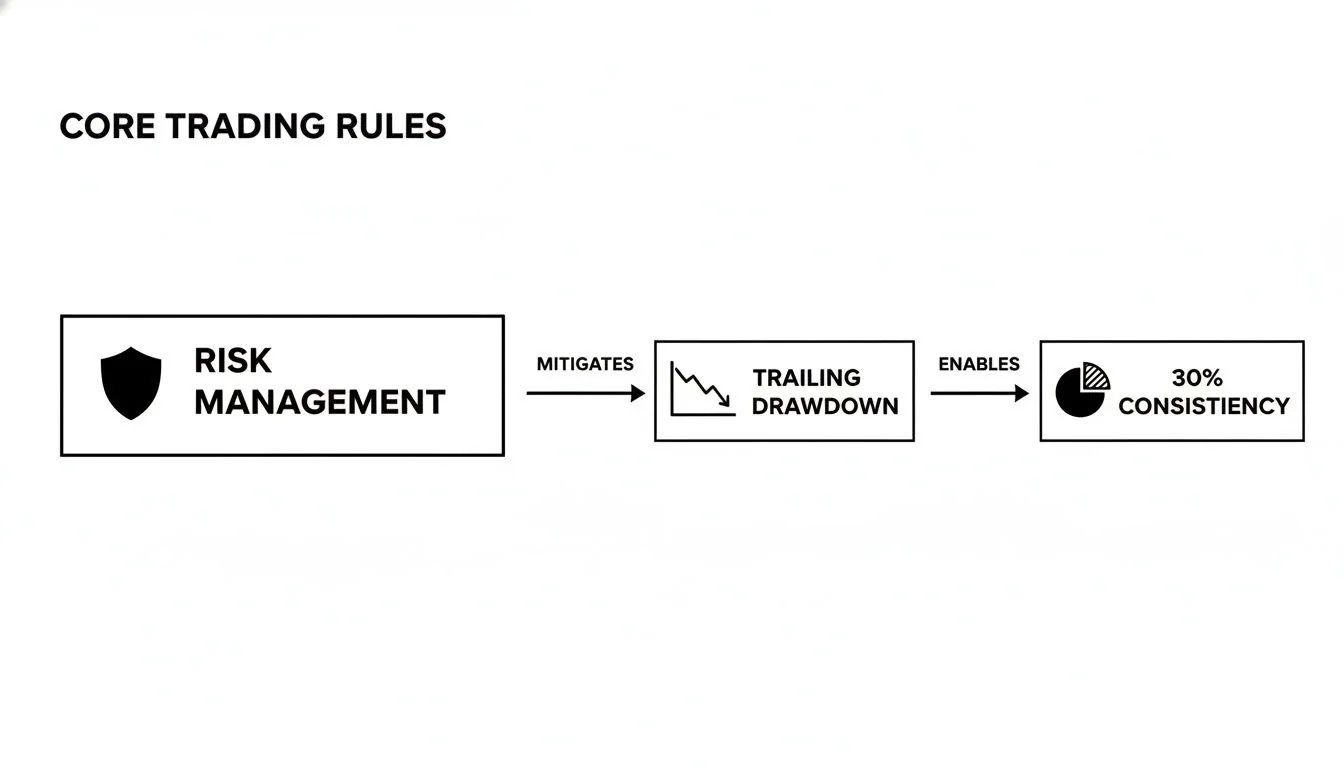
As you can see, if you can’t get a handle on risk, the other rules become almost impossible to follow.
The Shift from Dynamic to Static Drawdown
Here’s the good news: this constant “trailing” behavior isn’t permanent. Once you pass your evaluation and get into a Performance Account (PA), the rule changes after you build up a specific profit buffer. This buffer is your account’s starting balance plus the drawdown amount, plus a tiny $100 cushion.
Let’s use our $50,000 account again:
- Buffer Target: $50,000 (starting) + $2,500 (drawdown) + $100 = $52,600.
- Locked Drawdown: The moment your account balance hits $52,600, your drawdown threshold locks permanently at your starting balance of $50,000.
This is a complete game-changer. Your drawdown is no longer a scary, moving target; it becomes a static floor. From that point forward, you have a much bigger cushion to work with, giving you the breathing room your strategy needs. It’s your reward for proving you can manage risk.
Mastering this single rule is directly tied to success. My own analysis shows that traders who truly get this rule have 35% fewer violations than their peers. And when roughly 50% of all evaluation failures are tied to drawdown mistakes, it’s clear where your focus should be. If you want to dive even deeper, there are some great video breakdowns on the specifics of the Apex drawdown rules that I found helpful.
Practical Tips for Managing Your Drawdown
Staying above that trailing threshold isn’t about avoiding losses; it’s about managing them relative to your account’s peak. It requires discipline and constant awareness.
Here are the strategies that have worked for me and others I’ve coached:
- Know Your Number: Always, always know your current trailing drawdown threshold. Your Rithmic or Tradovate dashboard shows this, usually labeled “Auto Liquidate Threshold.” Check it daily.
- Use a Hard Stop-Loss: Never enter a trade without one. A single runaway loss is the fastest way to blow your account and fail the evaluation. No exceptions.
- Scale Out of Winners: Instead of holding out for a home run and risking a full reversal, get in the habit of taking partial profits. This banks realized gains and, more importantly, reduces the risk of giving back those unrealized profits that pushed your drawdown up.
- Plan Your Risk Differently: Don’t define your risk per trade as a percentage of your account balance. Instead, calculate it as a percentage of the distance to your drawdown threshold. This makes your risk adaptive and keeps you safe.
Tools can really help you get a feel for this. Before you even place a trade, you can use a prop firm intraday trailing drawdown calculator to run different scenarios. Playing with the numbers builds an intuition for how it works in a live market. Once you get proactive about managing this rule, you can finally stop worrying and start focusing on your strategy.
Understanding the 30% Profit Consistency Rule
After you’ve managed to stay above the trailing drawdown, there’s one last hurdle that trips up a ton of traders right before their first payout: the 30% Profit Consistency Rule. I’ve seen it happen countless times. This rule isn’t about just surviving in the market; it’s about proving your strategy is repeatable and not just a one-hit wonder. Apex is looking to fund consistent traders, not gamblers who got lucky once.
Here’s the deal: this rule only comes into play when you request a withdrawal from your Performance Account (PA). It states that no single trading day’s profit can make up more than 30% of your total profit when you ask for a payout. It’s their way of making sure you can grind out steady gains, which is what professional trading is all about.
Seeing how this works in a real-world scenario is the key to actually getting paid.
What the 30% Rule Looks Like in Practice
Let’s say you passed your evaluation and are now crushing it in a PA. You have a monster week and your account is up $10,000. You’re pumped and ready to request that first payout. But when you look at your trading log, you spot a problem.
That huge $4,000 gain you made on Tuesday was a home run, but your other winning days were much smaller.
When you request the payout, Apex will do the math: your $4,000 day is 40% of your $10,000 total profit. That’s over the 30% limit, and they will deny your payout request.
The solution isn’t to trade badly and give the money back. You have to keep trading profitably. Your goal is to increase your total profit so that the $4,000 day becomes 30% or less of the new, larger total. This forces you to prove your strategy has legs and isn’t just a fluke.
This consistency rule has become a major part of the Apex program, really taking center stage in their 3.0 update. It’s designed to filter out lucky wins and promote better trading habits. Community-reported data I’ve seen suggests that traders who master this rule have up to a 40% higher payout approval rate. It’s a big deal—in fact, reviews suggest that over 70% of all denied payout requests are because of this exact rule violation.
How to Stay Compliant and Get Paid
You can’t just ignore this rule and hope for the best at payout time. You have to be proactive and build it into your trading plan from day one in the PA.
Here are a few strategies that have helped me and others stay on the right side of this rule:
- Have Realistic Daily Goals: Forget about trying to hit massive, account-doubling days. Set a reasonable daily profit target. Once you hit it, seriously consider walking away. A string of consistent, smaller wins is infinitely better than one volatile home run followed by choppy results.
- Scale Out of Your Winners: Instead of holding a big winning trade for every last tick, start taking partial profits. This locks in gains and smooths out your P&L by distributing your profit across different price levels and times.
- Track Your “Best Day” Percentage: Keep a simple tally of your total profit and the profit from your single best day. If you see your best day creeping up toward that 30% mark, you know it’s time to focus on banking some smaller, consistent wins to rebalance things.
Juggling these numbers in your head can be a pain, especially when your account balance is always changing. To make life easier, I strongly recommend using a prop firm consistency rule calculator to see where you stand. A simple tool like this can save you from the massive headache of a denied payout.
Your Step-by-Step Guide to Getting Paid
Passing your evaluation is a huge milestone, but let’s be real—the whole point is to turn those screen profits into actual cash in your bank account. This is where you transition from the evaluation to a live Performance Account (PA). Getting this next part right is just as critical as passing the test in the first place.
This is your playbook for getting paid. We’ll walk through everything from the moment you pass the evaluation to seeing that first deposit hit your account. I’ll break down the trading day requirements, withdrawal schedules, and the all-important profit buffer you need to build before cashing out.
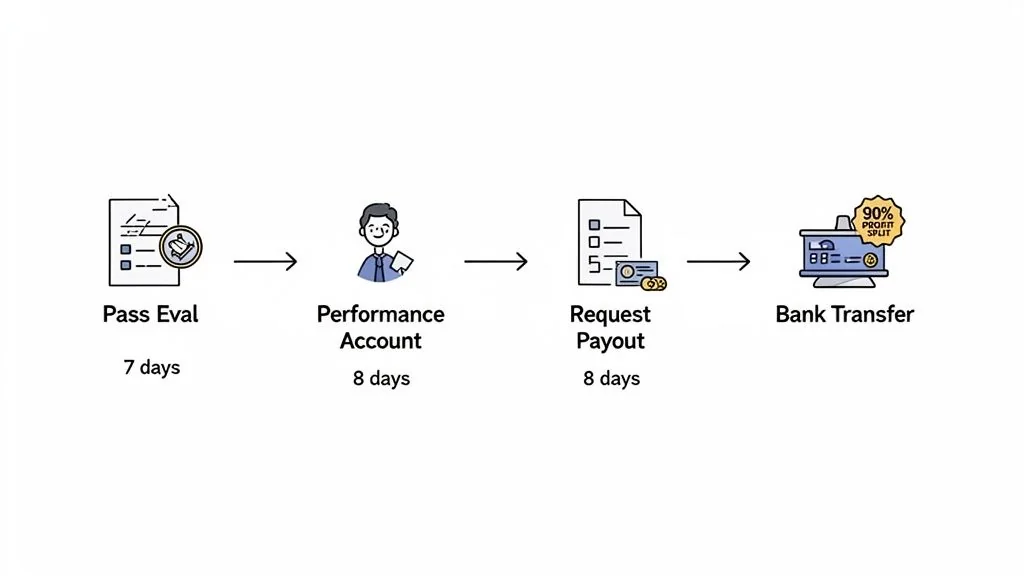
Think of this as the financial side of your new funded trading career. Let’s make sure you get rewarded for all that hard work.
From Evaluation Pass to Performance Account
The second you hit your profit target (and have traded for at least 7 days), the clock starts on getting your PA account. Apex is usually quick about it; I typically see an email with instructions land in my inbox within a day or two.
You’ll have to sign a contract for the PA account and cover a one-time activation fee. This fee, which varies by account size, pays for your data and platform access. Once that’s settled, you’re officially a funded trader with a live-funded PA account.
The rules in the PA are practically identical to the evaluation—you still have the trailing drawdown and the 4:59 PM ET cutoff. The big shift is your mindset; you’re no longer just trying to pass a test. Now, you’re building real, withdrawable profit.
The Profit Buffer and Payout Requirements
Before you can request your first dollar, Apex requires you to build what they call a “safety net.” This is a profit cushion that sits on top of your starting balance, protecting the firm’s capital and giving you some breathing room.
The size of this buffer is the same as your account’s trailing drawdown. For example, on a $50,000 account with a $2,500 drawdown, your account balance must reach $52,500 before you can even think about a withdrawal.
This profit buffer is non-negotiable. I’ve seen traders try to withdraw before hitting it, and the request is always denied. Think of it as the final exam: prove you can not only make money but also manage and protect capital.
Once you’ve built that buffer, you can start eyeing your first payday. But first, you have to check a few more boxes:
- Minimum Trading Days: You must trade on at least 8 separate days in your PA account before making your first withdrawal request.
- 30% Consistency Rule: We’ve touched on this before, but it’s crucial here. No single trading day’s profit can account for more than 30% of your total profit when you request a payout.
- Payout Windows: Apex has two specific payout periods each month. You can’t just request money whenever you feel like it; you have to submit during these designated windows.
Navigating the Payout Schedule and Profit Split
Getting the timing right is key to managing your cash flow. Apex processes payouts twice a month, and you have to get your request in while the submission window is open. Payouts are usually sent out within a few business days after the window closes.
Now for the best part. Apex structures its payouts to reward you heavily, especially at the start. Here’s the deal:
- First $25,000: You keep 100% of the first $25,000 in profits you make across all your PA accounts. That’s right, all of it.
- After $25,000: Once your total earnings cross that $25,000 mark, the split shifts to a 90/10 model. You still take home an incredible 90% of all future profits, while Apex gets 10%.
Honestly, this payout structure is one of the main reasons so many traders flock to Apex. It’s designed to get money in your pocket quickly and generously rewards consistency. When you nail these apex trading rules for payouts, you can finally turn your trading skills into a legitimate income stream.
Permitted vs. Prohibited Trading Strategies
One of the first things that drew me to Apex was how few strategy rules they seemed to have, especially compared to other prop firms that hand you a laundry list of what you can’t do. Apex gives you a ton of rope, which is great for experienced traders who already have a working system.
But it’s crucial to understand where they draw the line. While you have freedom, there are a few hard-and-fast rules that will get your account shut down instantly, no questions asked. Getting this right is just as important as managing your drawdown.
What You’re Allowed to Do
Apex is refreshingly hands-off with most trading styles. They trust you to use your own edge without putting you in a strategic straitjacket. This is a core part of their model and a big reason why traders with different approaches can succeed here.
Here are the key freedoms you have:
-
News Trading: You can absolutely trade during major news events. Whether it’s an FOMC announcement or a Non-Farm Payrolls report, you can hold positions or open new ones. This is a massive advantage, as many other firms will close your account for trading during red-folder news.
-
Using EAs and Indicators: You are free to use most Expert Advisors (EAs), indicators, and other tools you find on platforms like NinjaTrader and Tradovate. As long as your tool isn’t designed to game their system or perform a prohibited activity, you can use it.
The bottom line is simple: if you have a legitimate strategy that works, Apex wants you to use it. They are backing your skill, not trying to force you into their preferred way of trading.
What You Absolutely Cannot Do
While Apex is flexible, they are extremely strict about a few activities they consider abusive. I’ve seen traders lose their accounts over these, so pay close attention. Violating any of these rules means immediate account termination and losing any profits you’ve made.
These rules exist to protect Apex from strategies that don’t reflect real trading skill in a live market environment.
Here’s the stuff that will get you banned:
Collusive Trading: This is the big one. You can’t use multiple accounts to hedge positions against each other. For example, going long on ES in one account while simultaneously going short on ES in another one of your accounts is a cardinal sin. This is seen as trying to game the evaluation and is strictly prohibited.
-
Exploitative Automated Strategies: While EAs are generally okay, any bot designed to take advantage of demo environment inefficiencies is banned. Think high-frequency trading (HFT) bots or anything that racks up tiny profits so fast it wouldn’t work in a live market with real fills and slippage. If your bot isn’t viable in live conditions, don’t use it.
-
Group-Copied Trading: You cannot coordinate with a group of other traders to copy the exact same trades from a single signal provider or leader. Apex is funding individual traders, not large groups executing an identical strategy in lockstep.
-
Account Management by a Third Party: Your account is for you and you alone. You cannot let someone else trade it for you. This is a direct violation and will get your account closed immediately.
Think of it this way: Apex gives you the car and the gas, but you have to be the one driving, and you have to follow their few, but very important, rules of the road. One violation can wipe out months of hard work.
Apex Trading Strategies Do’s and Don’ts
To make it crystal clear, I’ve put together a table that breaks down the allowed behaviors versus the prohibited ones. I’d recommend printing this out or saving it somewhere you can see it easily when you’re first starting.
| Strategy / Behavior | What’s Allowed (Do) | What’s Prohibited (Don’t) |
|---|---|---|
| News Trading | Trade freely during FOMC, NFP, and other major news events. | No restrictions. |
| Automated Trading (EAs) | Use EAs and bots that execute a legitimate, real-world strategy. | Don’t use HFT bots or systems designed to exploit demo server latency. |
| Multiple Accounts | Trade multiple accounts with your own unique strategies. | Don’t trade opposing (hedged) positions across your different accounts. |
| Trade Copying | Use a trade copier to mirror your own trades across your own accounts. | Don’t participate in group copy trading from a single external source. |
| Account Access | You are the only person trading your account. | Don’t give your login to a third party or pay for an account management service. |
At the end of the day, Apex’s rules on strategy are about ensuring fair play and genuine skill. As long as you are trading your own strategy in good faith and not trying to find a loophole in their system, you’ll be in the clear.
Common Mistakes and How to Avoid Them
In trading, learning from your own mistakes is expensive. Learning from someone else’s? That’s just smart. When it comes to the apex trading rules, plenty of traders learn the hard way.
It’s not just about the big, obvious rules like “don’t hit your drawdown.” The real account-killers are the subtle, easy-to-miss details that trip up new and even seasoned traders. These are the pitfalls that cost you time, money, and that funded account you worked so hard for.
Many traders think they understand the drawdown rule, but they completely miss its real-time, intraday nature. They glance at their end-of-day balance and think they’re safe, totally forgetting that the trailing drawdown locks in based on your unrealized peak profit. A single winning trade that reverses can shrink your risk buffer permanently—a brutal lesson many of us learn too late.
Then there’s the 30% consistency rule, which traders often blow past until they hit the payout button, only to get a rejection email. These aren’t just little administrative details; they’re core filters designed to weed out undisciplined traders. Let’s break down how to avoid these common account-killers.
Misunderstanding the Intraday Trailing Drawdown
This is, without a doubt, the most common and costly mistake I see. Traders assume the drawdown is calculated on their closing balance. It’s not. It’s far more dynamic and, frankly, unforgiving.
Picture this: you’re in a $50,000 account with a $2,500 drawdown. Your failure threshold—the line you can’t cross—starts at $47,500. You jump into a trade, and it rips in your favor, showing a $1,500 unrealized profit. At that very second, your account’s peak value hits $51,500.
The system instantly ratchets up your failure threshold to $49,000 ($51,500 – $2,500). Even if that trade reverses and you close it for a small loss, that $49,000 floor is now locked in. Forever. You just permanently lost a huge chunk of your risk buffer and might not have even noticed.
Preventative Strategy:
- Watch Your “Auto Liquidate Threshold”: This is the only number that matters. Find it in your trading platform and keep an eye on it. This is your real, live failure point.
- Take Partial Profits: Don’t let big unrealized winners evaporate. Scaling out of trades banks actual profit and stops your drawdown floor from creeping up on a gain you never even captured.
Ignoring the 30% Consistency Rule Until Payout
This one is less of an instant account-killer and more of a slow, frustrating burn. So many traders laser-focus on hitting the profit target, sometimes smashing it with one monster home-run day. They pass the evaluation, build up a nice cushion in their Performance Account (PA), and then get a nasty shock when their first payout request is denied.
The rule is simple: at the time of your withdrawal request, no single trading day can make up more than 30% of your total profit. So, if you have a $10,000 profit balance but one of your days was a $4,000 winner, you can’t get paid. The system sees that as a fluke, not consistent trading. You’ll have to keep trading and make more money on other days to bring that big day under the 30% threshold.
Preventative Strategy:
- Track Your Best Day: Keep a simple notepad or spreadsheet. Write down your total profit and the profit from your single best day. A quick calculation will tell you if you’re in compliance.
- Set Daily Profit Caps: This sounds counterintuitive, but it’s key for consistency. Once you hit a solid, reasonable profit for the day, consider walking away. A series of smaller, repeatable wins is far more valuable for long-term payouts than one lottery-ticket day. This simple habit ensures you meet the apex trading rules for payouts without any last-minute surprises.
Frequently Asked Questions About Apex Trading Rules
Even after you’ve got the main rules down, a ton of specific questions pop up once you actually start trading. I know they did for me. This is where the rubber meets the road.
Let’s clear up some of the most common questions I see traders asking. Think of this as the practical, “what if” guide to trading with Apex.
Can I Trade on Multiple Apex Accounts?
Yes, and this is a huge part of the Apex strategy for many traders. You can run up to 20 Performance Accounts (PAs) at the same time, which is how many traders scale their profits.
But there’s one critical rule you can’t break: no collusive trading.
This means you absolutely cannot hedge your bets across accounts. For example, you can’t go long on the ES in one account and short the ES in another. Each account has to be traded on its own merits, not as a way to game the system or create a risk-free position.
How Does the Payout Schedule Work?
Apex handles payouts two times every month. You have to put in a request during one of the two specific timeframes.
- The first window is from the 1st to the 5th of the month.
- The second window is from the 15th to the 20th of the month.
Once your request is in and gets the green light, the money usually hits your account in a few business days. Just remember, you have to qualify first. That means meeting all the criteria, like building up your profit buffer and staying within the 30% consistency rule.
Are There Any Restrictions on News Trading?
No, there are zero restrictions on trading during big news events. You’re free to hold a position or open a new one right through an FOMC announcement or a Non-Farm Payroll (NFP) report.
This is a massive advantage. Many other prop firms will straight up close your account for news trading. Apex giving you the freedom to trade your strategy during those volatile moments means you don’t have to sit on the sidelines when your best setups appear.
Be smart about it, though. News can cause insane volatility and slippage. While Apex allows it, it’s on you to manage your risk so you don’t blow through your trailing drawdown in a matter of seconds.
At FinSeeds, we’re all about giving you the straight facts on prop trading, based on what we’ve learned from being in the trenches. Our guides, reviews, and free tools are built to help you skip the costly mistakes and trade with clarity. Check out all our resources at https://finseeds.com.
Keep reading